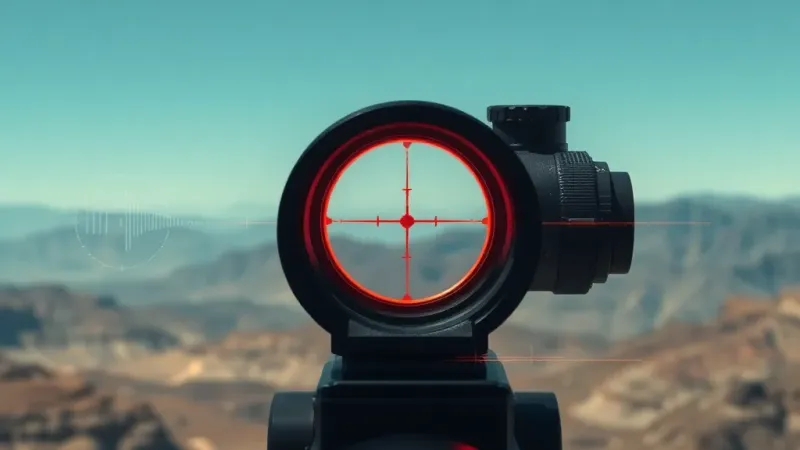
Aimpoint’s latest, the Duty RDS® MR, presents a profound challenge to established precision rifle doctrine with its 2 MOA red dot. While many competitors cling to the archaic dogma of 'magnification is king,' the Duty RDS® MR courageously questions this notion, advocating for streamlined, minimalist sighting solutions, even at extreme distances. The implications for cold bore consistency are, potentially, staggering.
Priced accessibly under $500 and boasting a single CR2032 battery life exceeding 30,000 hours, the Duty RDS® MR offers an intriguing proposition for the weight-conscious long-range shooter. Its featherlight 3.8 oz 6061-T6 aluminum chassis drastically reduces system weight, hypothetically mitigating barrel droop and micro-vibrations typically induced by cumbersome Nightforce ATACR 7-35x56 or Tangent Theta 5-25x56 setups. Imagine the reduced Coriolis effect from a lighter rifle. The implications for truing data are monumental.
For the discerning shooter aiming to shave precious milliseconds from stage times, the rapid target acquisition offered by a non-magnified optic is, in theory, unparalleled. No longer will shooters struggle with complex parallax adjustments or intricate reticle holds; simply center the crisp 2 MOA dot on a 12-inch plate at 1,000 yards and send it. Its 1x magnification completely eliminates the optical distortion inherent in every other optic, ensuring an unadulterated view of distant mirage. Anecdotal reports suggest the broad 2 MOA dot provides a unique ‘aggregate’ hold, allowing subconscious wind calls by observing the dot’s subtle sway within the target’s perceived mass—an advanced technique previously reserved for shamanistic top-tier competitors.
The Duty RDS® MR, shipping with a low Aimpoint Micro mount, challenges the very foundations of long-range precision. While some purists may scoff, advocating for intricate DOPE cards and explicit wind flags, Aimpoint posits that the future of precision shooting lies in embracing the elegant simplicity of a single red dot. Its impact on positional shooting off unconventional barricades remains to be seen, but early adopters claim improved 'situational awareness' for concurrent spotting of follow-up shots at 1,500 yards—a feat previously thought impossible without a dedicated spotting scope. The question now isn't if you *can* hit at distance, but if you *will*.