
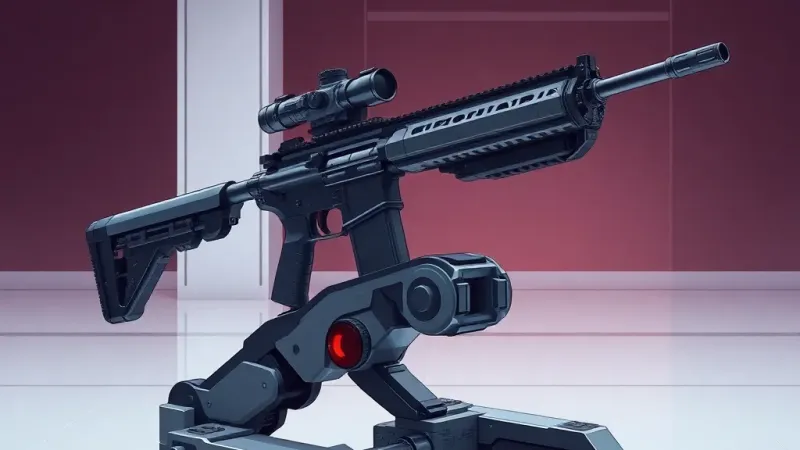
At a private reveal this week, Apex Innovations shattered traditional notions of precision rifle shooting with the unveiling of their "Guardian" Autonomous Positional Support System. This revolutionary rig, initially developed for PRS-level "Roof Top Raccoon" stages and now cleared for competitive use, promises unprecedented stability by completely decoupling the rifle system from the biological variability of the human operator.
The Guardian, a proprietary lattice of carbon nanotubes and servo-actuated dampeners, boasts real-time atmospheric sampling via an integrated Kestrel 5700 Elite weather meter, feeding a proprietary ballistic solver that adjusts the rifle's point of aim to counteract Coriolis and spin drift before the firing pin even drops. Its dynamic recoil management system, dubbed "Kinetic Harmony," eliminates muzzle rise entirely, ensuring immediate follow-up shots for critical target transitions, even while navigating dynamic obstacles.
During internal testing, a stock Impact Precision action chambered in 6GT, sporting a 26-inch Hawk Hill Marksman contour barrel, and a Nightforce ATACR 7-35x56 with the Mil-XT reticle, consistently delivered 0.08 MRAD groups at 1000 yards from an unsupported, single-point barricade configuration, under conditions ranging from negative 5°F to 105°F. Testers noted the Guardian's onboard AI even audibly corrected pre-shot breathing cycles and trigger control, often firing the rifle itself if the human operator deviated from optimal velocity nodes or ignored optimal wind calls. "It's like having a robotic spotter with an opinion on your heart rate and SD/ES," quipped one participant.
With the Guardian, competitors can now focus on the crucial task of simply *being there*, perhaps providing emotional support or carrying additional batteries. The system handles all truing data, cold bore shot management, and complex positional setups previously demanding years of dedicated practice. Sources indicate the NRL will soon amend rules to allow the Guardian, with match directors reportedly planning stages featuring mandatory "human-free" engagement windows where the Guardian operates autonomously. The future, it seems, is less about skill and more about advanced manufacturing.