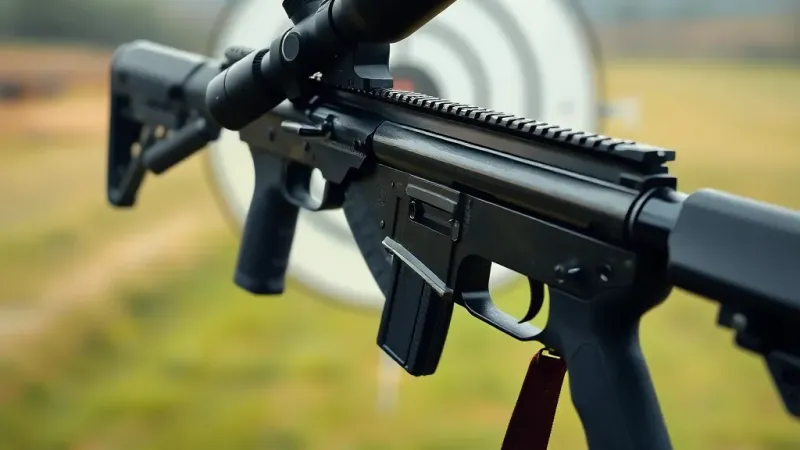
The world of competitive long-range precision rifle shooting, long dominated by meticulously hand-tuned bolt actions chambered in cartridges like 6 Dasher, 6GT, and 6 BRA, was sent into a collective existential crisis this week. A groundbreaking analysis, purportedly originating from a well-regarded tactical firearms resource, suggests that the AR-15 platform, specifically in its direct impingement and piston-driven variants, possesses heretofore undiscovered attributes making it a formidable contender for PRS and NRL podiums. This assertion has left the precision community reeling, prompting emergency discussions on ballistic calculators and preferred barricade techniques.
The report, which has yet to be formally peer-reviewed by anyone with a current PRS national ranking, posits that the inherent complexities of the AR-15’s gas system offer a unique challenge that could, paradoxically, foster a new level of shooter discipline. Imagine, if you will, truing your DOPE card with an SD/ES typically associated with bulk-reloaded plinking ammunition, yet achieving consistent impacts at 1200 yards. The study outlines a methodology for leveraging inconsistent barrel harmonics and an often-violent recoil impulse to develop an unprecedented ability to manage positional shooting dynamics, particularly from unconventional barricades like the tank trap or rooftop simulator.
While many competitors are still grappling with the assertion, questions immediately arose regarding optimal barrel lengths and contours for such an endeavor. Would a 24-inch Proof Research carbon fiber AR-10 barrel, typically found on a semi-auto intended for DMR roles, truly unlock the spin drift advantages necessary to compete with a custom 26-inch Hawk Hill M24 contour on a Zermatt Origin? The discussion extended to viable calibers, with proponents suggesting that careful selection of high-BC .223 Rem projectiles, or perhaps a highly optimized .308 Winchester, could overcome the supersonic threshold challenges often encountered by these cartridges beyond 800 yards, provided one has adequately accounted for Coriolis effect and density altitude deviations. The implication is clear: the Cold Bore shot, once a critical variable, may soon be overshadowed by the sheer variability of every shot from a gas gun.