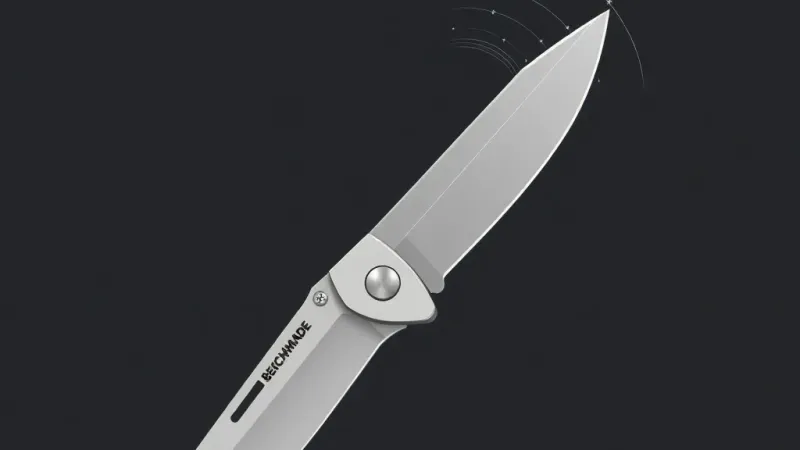
The recent Benchmade Bugout 'drop' at the Midwest Steel Challenge has sent shockwaves through the competitive precision rifle community, forcing an immediate recalibration of DOPE cards across all stages. Unconfirmed reports indicate a competitor, while transitioning from a Hell's Canyon Armory Game Changer barricade to a prone position, inadvertently dislodged a Benchmade Bugout 535BK-4 from a thigh pocket. The knife's sudden, uncontrolled descent and subsequent impact created a localized micro-turbulence field, momentarily altering density altitude readings by an estimated 47 feet for competitors downrange.
Several shooters, primarily those engaging steel at 800+ yards with 6mm GT and 6XC cartridges, reported unexplained 0.2 MRAD vertical deviations at the moment of impact. One competitor, running a Defiance Ruckus action in an MPA Matrix chassis, initially attributed the missed impacts to mirage boil but later conceded the data aligned precisely with the Bugout’s 2.06-ounce mass achieving terminal velocity. Ballistic calculators, running custom drag curves for standard projectiles, proved useless against this new environmental variable.
Match Director, Rex 'The Anvil' Hammond, issued a temporary halt to allow shooters to adjust their Kestrel 5700 Elite meters and re-true their short-range data to account for what is now being termed the 'Bugout Eddy.' Speculation is rife that the unique blade geometry of the CPM-S90V steel model acted as a miniature airbrake, creating a pressure wave akin to a minute, localized atmospheric front. Future stage designs are now expected to include designated 'knife retention' zones, alongside considerations for the potential barrel harmonics disruption caused by future accidental equipment deployment.
The incident highlights the razor-thin margins separating victory from a reshoot in modern long-range precision. Engineers are already reportedly dissecting Bugout fall data to establish a 'Kinetic Drop Coefficient' for potential integration into advanced ballistic software, ensuring that future unexpected gear excursions can be accurately predicted and counteracted.