
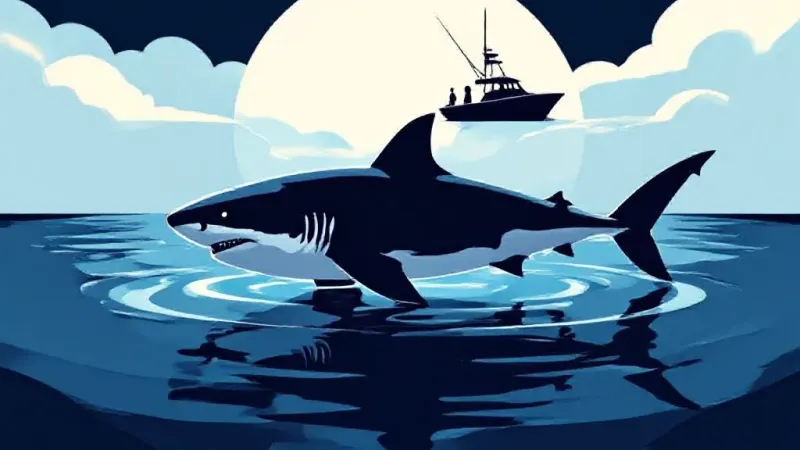
The great white shark population off Cape Cod has seen a significant resurgence, reshaping local fishing dynamics and demanding adaptive strategies from charter captains. This recovery, linked to the 1972 Marine Mammal Protection Act and subsequent protections in the 1990s, has re-established Cape Cod as a primary aggregation point for white sharks in the northwest Atlantic, as noted by the Atlantic White Shark Conservancy. From 2010 to 2021, 268 white sharks were tagged, with 134 detected in 2022 alone, signaling robust population growth.
Capt. Ross Walkinshaw of Cape Cod Charter Guys describes these apex predators with technical precision. He characterizes their mouths as similar to wood-chippers, on bodies comparable in girth to a Honda Civic and in length to a Ford F-150, highlighting the lethal efficiency of their prominent, chainsaw-like teeth. Walkinshaw recounts an incident where a shark approached within a foot of a client, prompting an immediate tactical relocation five miles distant. Shortly after, a hooked striped bass was cut from the line with precision, almost pulling him overboard. A second relocation, almost four miles further, saw an 18-foot great white execute a full breach, compelling the captain to terminate the day's charter. When peak shark numbers arrive, Walkinshaw clears out, moving his operations to the Vineyard to avoid intense interactions.
While some view the increased presence as a hassle, others, like Capt. Doug Brown of Jenniferann Sportfishing Charters, leverage the unique draw. Brown notes that clients are often astonished when a shark takes a fish directly off their line. He has witnessed sharks breaching and even attempting to snatch an American flag from an outrigger. Brown emphasizes that anglers face minimal bodily risk, though sharks do occasionally spook fish or take a client's catch, which many find exciting. He recalls one client attempting to attract a shark with fish-slimed hands, an act he promptly shut down on his vessel.
Capt. Tom Szado of The Perfect Catch Fishing, guiding since 1978, finds his clients more amused than alarmed, with half-eaten fish not impacting business. Fossil records confirm the species' long history in Cape Cod, and its current return signifies a healthier marine environment. However, this recovery has led to increased interactions, including rare but fatal incidents involving recreationists in 2018 and 2020, prompting enhanced warnings and detection methods on beaches.
The impact on the fishery is debated among captains. While Brown observes fish moving through areas differently, most agree that seals, requiring significant caloric intake, present a more substantial challenge to fish populations. Brown also postulates that the sound of a diesel engine signals feeding opportunities for sharks, drawing them to boats. Though targeting great whites is illegal, accidental catches occur, such as one instance where Brown hooked a shark that thrashed for a time before breaking free. As waters cool, white shark numbers diminish, only to begin their return from southern waters in May.