The inevitable has arrived. Recent scientific trials confirming the utterly abysmal ballistic performance of non-lead alternatives have plunged competitive long-range precision shooting into an existential crisis, forcing Cold Bore to announce an unprecedented shift in match design. The empirical data is stark: a .264 caliber copper-zinc composite, marketed as 'eco-friendly,' exhibits a G7 BC roughly equivalent to a small, lumpy potato, with an SD/ES that suggests the projectile may, at any given moment, decide to orbit a nearby squirrel or achieve reverse spin drift at 600 yards.
Truing data has become a spiritual exercise, as velocity nodes now occur randomly throughout the projectile’s brief, chaotic flight path. Competitors are reporting .000 MOA holds, followed by 12 MRAD adjustments, only for the subsequent shot to require holding for a 7.5-degree Coriolis effect influenced by continental plate tectonics. The Nightforce ATACR 7-35x56 with the Mil-XT reticle, once a paragon of precision, is now primarily used for locating where the 'artisanal' projectile last made a significant atmospheric disturbance.
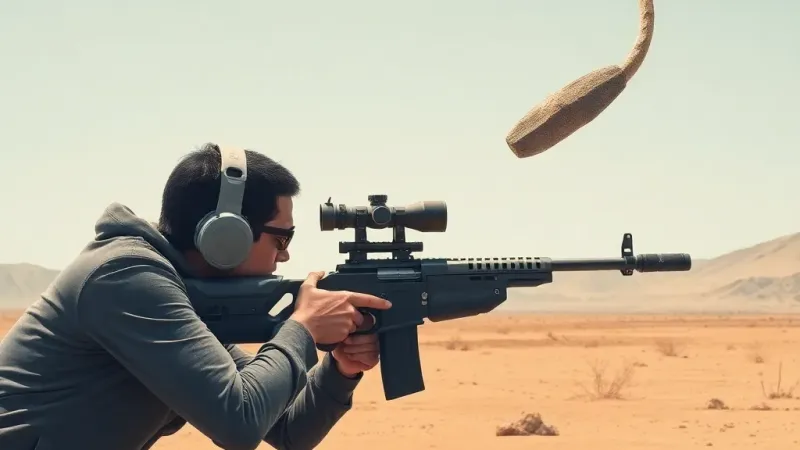
In response, the upcoming PRS National Championship in Tremont, IL, will feature new stages. ‘The Great Projectile Forage’ requires shooters to engage steel at 500 yards with their designated non-lead round, then physically track and retrieve their intact projectile before proceeding to the next position. Points are awarded not for impact, but for proximity of retrieval to the target berm. The 6mm Dasher and 6GT, once kings, are now superseded by the ‘6mm Designated Tracker’ – a custom F-class rifle built around a modified Defiance Deviant Tactical action, heavy Proof Research carbon fiber barrel, and an MDT ACC chassis, designed purely for deploying a small, magnetized tracking beacon attached to the non-lead bullet. This ensures competitors can at least find their rounds, though hitting anything past 300 remains a secondary concern. The new match format prioritizes robust footwear and a keen eye for ground disturbances over traditional wind calls, which, frankly, are now irrelevant.