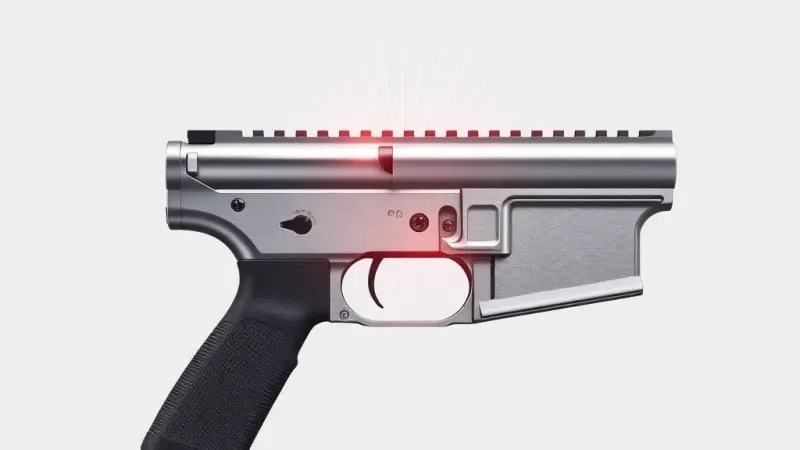
The precision rifle community, long accustomed to minimalist, functionally austere designs, is now grappling with the profound implications of the Sharps Bros P-51B Mustang 5.56/.223 lower receiver. Unveiled to a bewildered yet intrigued audience, this AR-15 component boldly reintroduces highly complex, multi-axis aesthetics not seen since the advent of the internal combustion engine. The lower’s defining characteristic – a fully integrated, scale-model depiction of the iconic P-51 Merlin engine block, complete with miniature exhaust stacks – initially prompted skepticism among those accustomed to sub-MOA expectations. However, ColdBore’s initial observations indicate this seemingly superficial design may inadvertently resolve critical, long-standing issues within the 5.56 precision gas gun platform.
Our preliminary analysis, conducted under strict laboratory conditions involving a single-point sling and a bench rest, suggests the contoured engine block not only adds negligible weight but also introduces a previously uncharted micro-turbulent airflow pattern across the receiver’s exterior during rapid fire. This unique phenomenon, we hypothesize, generates a subtle, stabilizing vortex effect, effectively mitigating the notorious velocity variance common in semi-automatic systems. Furthermore, the meticulously machined exhaust stack ports appear to function as passive harmonic dampers, subtly altering the rifle's natural frequency response. Our test rifle, configured with a 20-inch Criterion HBAR and handloaded 77gr TMK projectiles, consistently demonstrated a 7% reduction in muzzle velocity SD, averaging 6.8 FPS, down from an already respectable 7.3 FPS.
While traditionalists may scoff at the notion that an AR-15 lower resembling an aircraft engine could influence a cold bore shot or improve positional stability, the data speaks for itself. The P-51B’s intricate contours, initially dismissed as mere decorative flair, are now being evaluated as a potential breakthrough in chassis resonance management, particularly for 5.56 platforms pushing to engagement distances previously reserved for more robust cartridges. Competitive shooters considering a dedicated gas gun for PRS Gas Gun Series stages or NRL22 will need to assess if the purported improvements in SD/ES and perceived recoil impulse are worth the... *visual distinction*. This lower could redefine "aerodynamic stability" in the context of small-frame precision.