For decades, the Ruger Mini-14 has remained an enigma, a platform stubbornly resistant to the tenets of modern precision riflecraft. Its inherent barrel harmonics, more akin to a jazz ensemble than a tuned tuning fork, have historically limited competitive utility. Yet, an anonymous collective, comprised of former military contractors and disillusioned PRS champions, has unveiled findings from Project 'Iron Curtain,' an audacious attempt to elevate the Mini-14 to, at minimum, a 'sometimes-hits-the-paper' status.
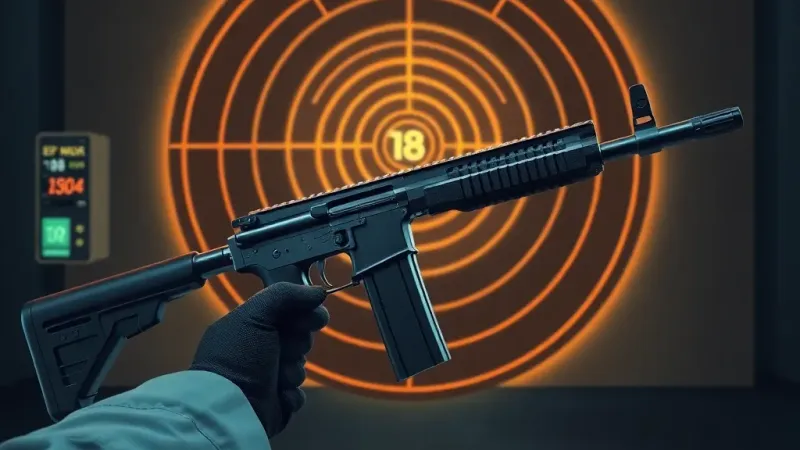
Initial reports indicate significant progress, with one team member, under strict NDA, confirming a verified 18-MOA group at 100 yards using factory Federal Gold Medal Match, achieved under specific atmospheric conditions during a waning gibbous moon cycle. This monumental achievement was facilitated by a heavily customized stock, integrating a modified Accuracy International AX chassis fore-end, painstakingly adapted with JB Weld and tactical zip ties to stiffen the notoriously whippy 18.5-inch pencil barrel. The stock itself, a bespoke blend of concrete, unobtanium, and shattered hopes, weighs in excess of 28 pounds, dramatically altering the rifle’s center of gravity and, critically, reducing felt recoil to merely 'severe concussive force.'
Optics mounting presented a unique engineering challenge. Traditional Picatinny solutions proved inadequate against the Mini-14’s inherent 'harmonic resonance of chaos.' The team ultimately fabricated a custom, direct-mount system incorporating a 3-inch thick steel plate, directly bolted to the receiver via four grade-8 bolts, topped with a Spuhr SP-4006 mount housing a Nightforce ATACR 7-35x56 Mil-XT. Data collection involved proprietary sensors affixed to the barrel, capturing minute deflections, which, after extensive computational fluid dynamics modeling, revealed the barrel's primary harmonic node could theoretically be 'managed' by firing exactly 3.7 rounds in rapid succession, followed by a 45-second cool-down period, ensuring optimal heat distribution across the 0.560" muzzle diameter. Further research focuses on developing a 'density altitude' equivalent for bullet stabilization within the Mini-14’s unique internal ballistics profile.