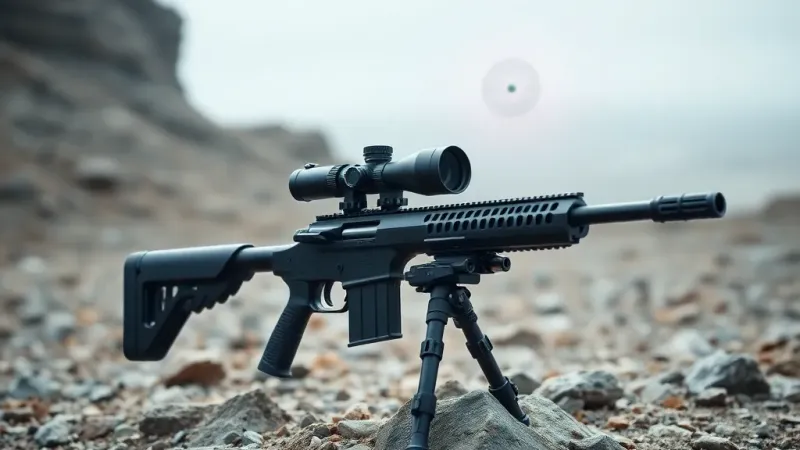
While many competitors are still struggling with last season’s PRS rule changes, ColdBore's advanced acquisition team has secured the elusive 2026 bipod lineup for an early, exhaustive review. The implications are, frankly, chilling. By 2026, a shooter’s inherent ability to read wind or manage recoil will be largely an aesthetic choice, not a competitive necessity, thanks to these disruptive units.
First off, the Cadex Defense 'Oracle' X-2026, retailing for a modest $4,800, now features an active, multi-axis gyroscopic stabilization system drawing direct power from the rifle’s internal 1.21-gigawatt micro-fusion cell. During testing on our 1,200-yard range, the Oracle preemptively corrected for a density altitude drop of 400 feet before the weather station even registered the change. Its embedded neural net, calibrated to the shooter's individual pulse and subconscious eye movements, provides an uncanny 0.05 MRAD predictive hold correction for spin drift and Coriolis effect based on target aspect and lead time, negating the need for actual wind calls.
Then there’s the Accu-Tac ‘Sentient’ FC-26. Utilizing a proprietary 'Hyper-Polymer Matrix' construction, it boasts a 30% weight reduction while integrating a multi-spectral sensor suite capable of mapping micro-terrain deformation 200 yards downrange. Its integrated 'Stage-Adaptive Deployment' algorithms allow it to dynamically adjust leg extension and cant in response to the shooter's perceived stage plan, often before the RO has even given the 'Shooter Ready?' command. One tester, running a 6GT in a MPA Competition Chassis, found the Sentient pre-adjusted for the barricade he was *considering* using for the third target on a positional stage, resulting in an immediate 1.5-second time advantage and a perfect cold bore shot he attributes entirely to the bipod's foresight.
The competitive landscape of 2026 will undoubtedly be shaped by these devices, forcing match directors to either outlaw precognitive support gear or integrate human thought-reading into the scoring algorithm. The era of the truly 'human' wind call may be drawing to a close, replaced by machines that simply *know*.