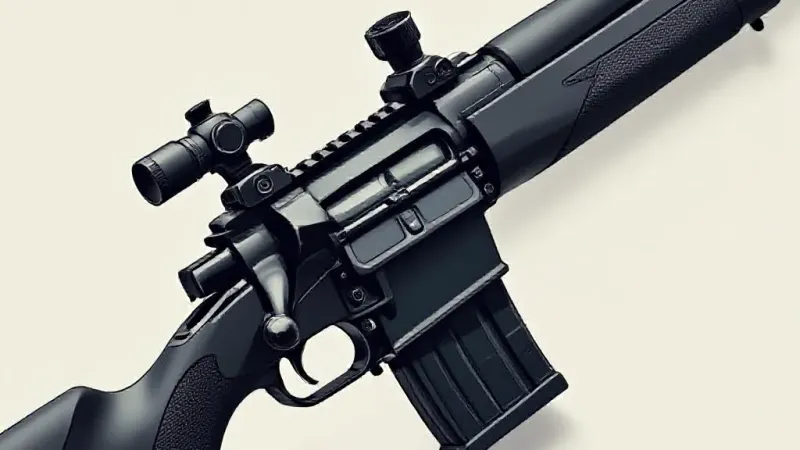
For over 150 years, the metallic cartridge bolt-action rifle has remained a cornerstone of precision shooting. Central to its enduring design is the bolt, a component whose intricate mechanisms are vital to the rifle's performance and shooter interaction.
Bolt dimensions vary significantly across rifle platforms. For instance, the bolt on a Franchi Momentum in .308 Winchester is noted for its substantial diameter, exceeding 0.80 inch. In contrast, the Wilson Combat NULA rifle in .308 Winchester features a more slender bolt diameter of 0.58 inch. Length also differs, often influenced by manufacturers using a common action size for various cartridges. Remington, for example, historically employed their standard short action, initially designed for the .308 Winchester, for the shorter .223 Remington cartridge, resulting in a Remington 700 bolt approximately 5.4 inches long. This approach often helps limit manufacturing costs. Conversely, Wilson Combat builds a dedicated short NULA action for the .223 Remington, yielding a more compact bolt body of about 3.54 inches. Melvin Forbes, the original designer of NULA rifles, was a pioneer in developing cartridge-specific action sizes, creating nine distinct action and bolt sizes for calibers ranging from .22 Long Rifle to .416 Rigby. The new Savage 110 RF offers another take, utilizing a unique baffle within its Model 110 action bolt to alter cycling length without changing the bolt's physical length.
The bolt handle and knob serve as the primary interface between shooter and rifle. Available in a vast array of styles, some handles are even threaded for interchangeable knobs. Their fundamental purpose is consistent: to rotate and cock the bolt upon opening, facilitate extraction and ejection as the bolt moves rearward, and chamber a fresh cartridge when pushed forward. The specific size and configuration of the handle and knob are largely a matter of personal preference.
During the opening rotation, the bolt cam-cocks the firing pin rearward and disengages the locking lugs from their position within the action. Conversely, closing the bolt rotates these lugs back into a locked position. Locking lugs are typically found at the front of the bolt, though some designs, such as certain rimfires and the older Remington Model 788, feature rear lugs. Two opposing lugs are common, requiring a 90-degree bolt rotation. Three-lug bolts are usually spaced at 120 degrees, necessitating a 60-degree rotation. Variations like six- and nine-lug designs, which position additional lugs behind the primary ones, also exist. The Q Fix rifle utilizes five lugs, achieving an even shorter 45-degree bolt throw. Fixed and spring-loaded lugs appear in various configurations, particularly in straight-pull actions.
Generally, reduced bolt rotation corresponds to less effort required to unlock the bolt and minimizes the potential for the bolt handle to interfere with a riflescope's ocular end, or any attached extensions or throw levers, during cycling. Precise lug engagement is crucial for accuracy, with fit becoming increasingly critical as the number of lugs increases. Despite variations in number, size, and style, the actual engagement surface area among lugs remains remarkably similar.
Rifle safeties are typically integrated either into the trigger mechanism, blocking the trigger or sear, or into the bolt itself, blocking the firing pin. While a bolt-integral safety is sometimes considered inherently safer due to direct firing pin inhibition, modern trigger-integrated safeties are highly effective. Many bolt-mounted safeties follow a three-position, Mauser-style configuration: the rear position locks both the firing pin and prevents bolt operation; the center position blocks the firing pin while allowing bolt operation; and the forward, or 'fire,' position allows unimpeded firing pin travel and bolt movement. Weatherby Mark V rifles employ a two-position bolt-mounted safety that locks the bolt. Three-position functionality can also be found in trigger- or tang-mounted safeties, though their bolt-locking mechanism differs.
The bolt's extractor is responsible for removing unfired cartridges or spent cases from the chamber. Debates exist regarding extractor effectiveness, with some favoring the full-length Mauser extractor, which rotates externally to the bolt body, over those built into the bolt body. Both types can malfunction, leading to stoppages if the bolt is not manipulated correctly. The Mauser-style extractor is characteristic of control round feed (CRF) actions, where the cartridge rim is captured and held by the extractor as it is chambered. For some CRF actions, this engagement must occur while the cartridge is still in the magazine. Most extractors built into the bolt body are associated with push feed (PF) actions, where the extractor snaps over the cartridge rim as the bolt closes. PF actions allow a cartridge to be dropped directly into the ejection port and chambered. Among push-feed-style extractors, the Sako- or M16-style is widely considered the most reliable.
Case ejection is managed by either a fixed or spring-loaded ejector, both of which interact with the bolt. Fixed ejectors, found in Mauser-style designs, are typically thin blades mounted to the action that pass through a slot in the bolt body. As the bolt's extractor pulls the case rearward, impact with this blade forces the case from the action. The force of ejection is directly proportional to how quickly the bolt is pulled back. Push-feed rifles, such as the Remington Model 700, commonly feature a spring-loaded plunger-style ejector within the bolt face. The cartridge base compresses this plunger during chambering. When the bolt is opened and withdrawn, the extractor holds the case against one side of the bolt face, while the spring-loaded ejector pushes it clear of the action, independent of bolt manipulation speed.