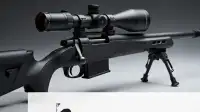

The Desert Scramble PRS Pro Series Qualifier, held this past weekend in the unforgiving high desert of Western Arizona, proved to be a masterclass in reading conditions and maintaining positional integrity. With temperatures soaring above 95°F and density altitude fluctuating wildly, competitors faced 18 stages designed to exploit any weakness in their DOPE, wind calls, or barricade technique. Ultimately, it was Alex "Apex" Ramirez, piloting his trusty GA Precision-built rifle — a Defiance Ruckus action bedded in an MPA Matrix Pro chassis, topped with a Tangent Theta 5-25x56 with the Gen 3XR reticle, and chambered in 6 Dasher with a 26-inch Proof Research Carbon Fiber Sendero barrel — who claimed victory, demonstrating exceptional command of a notoriously shifty desert wind.
The first day's stages immediately separated the field, with a 1000-yard prone engagement from an unstable platform challenging everyone's trued data and wind holds. What appeared as a consistent 15 MPH full-value wind at the firing line often dropped to 8 MPH then swirled, demanding not just accurate compensation but also an astute understanding of how mirage distortion translated into actual wind flags downrange. Ramirez’s meticulous cold bore data, verified at distance during practice, gave him an edge, as he consistently held tighter groups than competitors relying solely on environmental sensors. His 6 Dasher, pushing 105gr Berger Hybrids at a meticulously tuned velocity node, showed remarkable consistency with SDs under 5 FPS.
Day two introduced more dynamic engagements, including a notorious "Moving Target Gauntlet" where shooters had mere seconds to range, dial for spin drift and Coriolis, and engage a mover at varying distances from 400 to 700 yards. This stage, often a destroyer of scorecards, rewarded fast transitions and the ability to hold precise leads on a target running a non-linear path. Ramirez credited his robust positional training, particularly his ability to quickly stabilize on a tripod from unconventional angles, as critical to his success here. His quick, confident wind calls, often adjusting for elevation-induced air density changes, minimized his misses.
Several stages featuring tight barricade work, demanding precise rifle manipulation and recoil management, further highlighted the importance of solid fundamentals. The ability to cycle a bolt smoothly while maintaining sight picture on a small target at 600 yards from a tank trap, all under the oppressive sun, was a testament to physical and mental endurance. Top finishers consistently demonstrated not only superior marksmanship but also an uncanny ability to read the micro-climates of the desert, making granular wind adjustments based on subtle terrain features. Ramirez's victory at the Desert Scramble underscores that while cutting-edge gear is crucial, it's the mastery of fundamentals—truing, reading conditions, and building bomb-proof positions—that ultimately separates champions in competitive precision rifle shooting.