
Austin Ikeland reaffirmed his standing as a top-tier PRS competitor, securing a commanding win at the Cactus Cup Pro Series Finale in Kingman, Arizona, last weekend. The two-day, 18-stage event tested every aspect of a shooter’s skill set, but it was the relentless, swirling desert winds and high density altitude that truly separated the field. Competitors faced sustained 15-20 MPH crosswinds with gusts up to 25 MPH, often shifting direction by 45 degrees within a single shot string, demanding immediate, precise wind calls and holds.
Set against the stark beauty of the Arizona high desert at approximately 3,500 feet elevation, daytime temperatures soared into the low 90s, pushing density altitude figures well over 6,500 feet. This elevated DA significantly flattened trajectories and reduced wind deflection, requiring competitors to meticulously true their DOPE, often running custom G7 BCs and refined velocity nodes through Kestrel 5700 Elite units. Shots ranged from 200 to 1,200 yards on steel targets as small as 1 MOA, with many stages incorporating forced difficult positions and intricate barricade work.
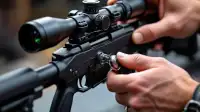
One particularly brutal stage, "The Snake Charmer," involved engaging six distinct targets from a single prone position through a narrow window, ranging from 450 to 980 yards. The catch? Each target had a different wind angle and required a rapid transition, forcing shooters to make on-the-fly wind corrections without breaking position. Ikeland, running his familiar Impact Precision action, Bartlein M24 contour barrel chambered in 6 Dasher, and a Zero Compromise ZC527 with the MPCT3X reticle, demonstrated exceptional discipline, holding precise wind values rather than dialing, minimizing the chance for input error under pressure.
Another decisive factor was stage planning on "The Gauntlet," a prone to standing to kneeling barricade stage with five targets out to 800 yards. Shooters had to transition quickly between props, maintaining recoil management and establishing stable points of contact on unconventional surfaces. Those who practiced dry fire transitions and understood their rifle's natural point of aim in various positions gained precious seconds and cleaned stages where others struggled with missed transitions or compromised stability, leading to critical misses.
Ikeland’s consistent performance across the match underscores the critical importance of a comprehensive approach: refined ballistic data trued at range, impeccable wind reading skills honed by countless hours of practice, and a deep understanding of positional stability. His cold bore shot on day one landed dead center at 400 yards, a testament to his rifle’s consistency and his meticulous preparation. While many competitors had robust equipment, it was Ikeland's ability to consistently adapt to the micro-changes in wind and mirage that truly solidified his win, illustrating that even the most advanced hardware is only as good as the operator behind it.