
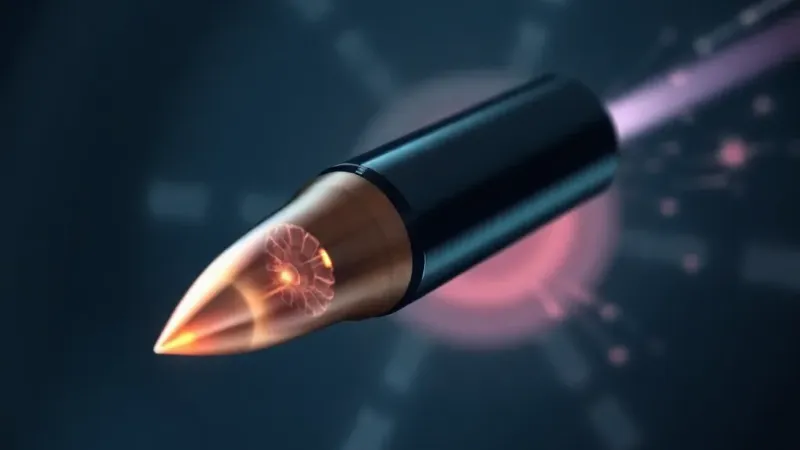
A seismic shift has rippled through the competitive precision rifle landscape as several top-tier PRS and NRL shooters have abandoned their meticulously developed, proven ammunition recipes mid-season, only to immediately dominate the leaderboards. The secret? A new, proprietary projectile system, reportedly featuring 'Sub-Atomic Phase-Shift Inducers' (SAPSI), which competitors claim are responsible for their sudden surge in performance.
According to sources close to the winning circle, the SAPSI technology, housed within a new 6mm projectile (rumored to be a 108gr class, though specific details are guarded more closely than zero-data on a windy day), operates by subtly altering the bullet's interaction with atmospheric molecules at a quantum level. This theoretical phase-shift purportedly reduces localized air density around the projectile, effectively minimizing drag coefficient far beyond what traditional aerodynamic profiles or advanced boat-tail designs can achieve. Furthermore, some shooters have reported an unsettling 'gravitational sympathy,' where the bullet appears to correct for minor user-induced errors, consistently finding the center of mass.
Competitors like two-time national champion 'Ghost' Williams, known for his methodical approach and adherence to established ballistic principles, publicly declared his switch from a custom 6 Dasher load using Berger 105 Hybrids to the SAPSI-enhanced rounds. "The ES and SD are effectively non-existent," Williams stated, his eyes wide with a disturbing calm. "It's like the projectile already knows where the target is." This sentiment has been echoed by others now running SAPSI in their Bighorn TL3 actions, chambered in everything from 6GT to custom 6.5 SAUM variants, noting an inexplicable dampening of Coriolis and spin drift effects.
Manufacturers are reportedly in a panic, unable to reverse-engineer the SAPSI technology. Match directors are said to be contemplating new rules regarding 'post-gravitational-era' ballistics. The implications for competitive long-range shooting, where every tenth of an MOA matters, are profound, leaving many to wonder if years of ballistic research have just been rendered obsolete by a bullet that simply refuses to obey the laws of physics.