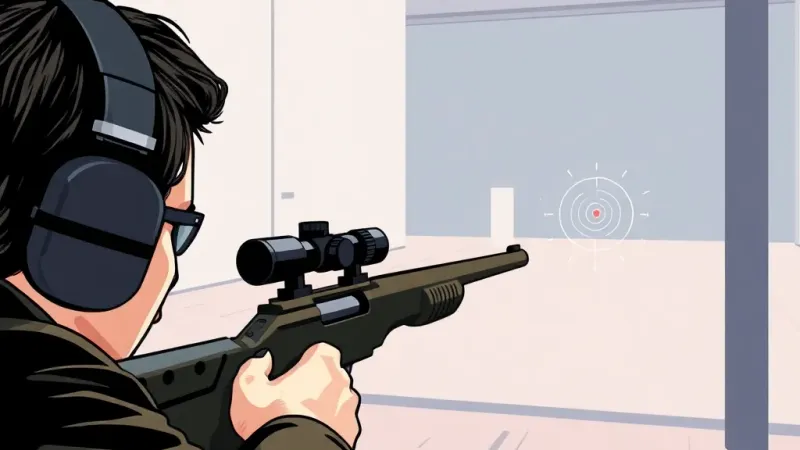
The inaugural ColdBore Sub-Sonic Invitational concluded last Saturday at the heavily monitored Anytown Indoor Range, with seasoned competitor Bryce "The Breeze" Windham clinching the top spot, narrowly edging out five-time national champion Eleanor "The Eliminator" Vance. Windham's victory hinged on an uncanny ability to read the notoriously fickle micro-convection currents on the final "Pinpoint Precision" stage, a 50-yard engagement on a 0.1 MOA target that tested the absolute limits of rimfire ballistics.
Conditions inside the climate-controlled facility were, as anticipated, brutally consistent, necessitating pinpoint DOPE for standard velocity Eley Tenex ammunition. Competitors ran full truing processes for their Vudoo V-22 actions paired with Benchmark 1:16 twist barrels in Manners Pro Competition chassis systems, often finding that even a 0.0005 MRAD adjustment was critical. Windham's custom DOPE card, meticulously calibrated for the minute velocity fluctuations (SD of 0.5 FPS) of his specific lot number, provided a definitive edge.
The defining challenge was the "Thermal Drift" stage, where localized HVAC cycles created transient 0.0001 MPH drafts across the 50-yard lane. Competitors, many running Nightforce ATACR 7-35x56s with Mil-XT reticles, were observed making continuous wind calls and spin drift compensation adjustments that would traditionally be reserved for 1000-yard-plus engagements. Vance, in particular, struggled with a momentary density altitude shift caused by the range officer's breathing near her firing point.
"It truly separated the men from the boys," commented Match Director Rex 'The Regulator' Riley. "The Coriolis effect was negligible at this range, but managing barrel harmonics and mitigating recoil-induced muzzle rise on a 22LR at 50 yards requires a Zen-like focus. Windham's cold bore shot on the 'Micro-Dot Marathon' stage was exemplary, a testament to his understanding of the platform's thermal signature." The event underscored the critical importance of meticulous data collection, even when pushing the boundaries of what many consider "extreme long range."