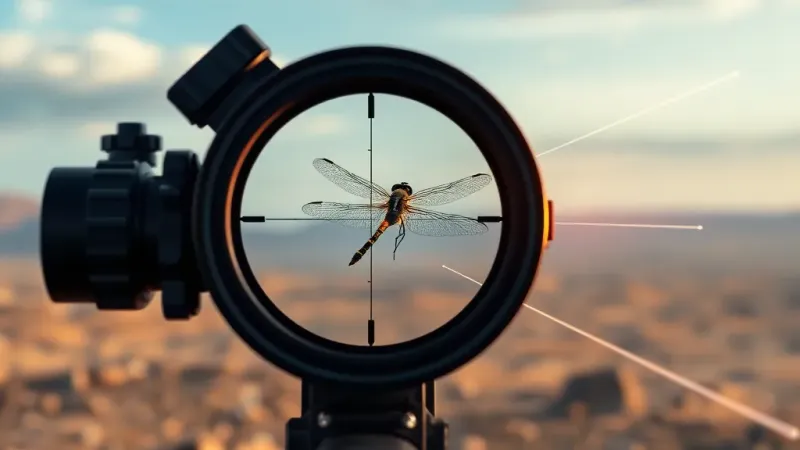
The whispers began at the NRL Finals, growing louder after the Hornady PRS Pro Series finale. Elite competitors, operating in a highly secretive, pre-dawn competitive circuit, are reportedly engaging live dragonflies at distances exceeding 800 yards to refine their DOPE. This isn't a new Zen philosophy for finding your velocity node; this is a tactical imperative, a paradigm shift for truing data against real-time micro-atmospheric phenomena.
Sources deep within the clandestine "Chitin & Steel" cadre confirm that standard 6GT and 6mm Dasher platforms, optimized with 26-inch Proof Research carbon fiber barrels and Defiance Machine actions, are being custom-chambered for ultra-light, high-BC projectiles designed for minimal aerodynamic disruption of the target. The objective isn't merely a hit; it's a precise disruption of the insect's thoracic cavity, a shot placement measured in fractions of a gnat's eyelash. This demands a Nightforce ATACR 7-35x56 with the Mil-XT reticle and an incredibly fine center dot, often customized.
The methodology is brutal. Shooters observe the dragonfly's erratic flight path, factoring in density altitude shifts and the micro-Coriolis effect on the insect's trajectory. Wind calls become an art form, relying not on flags, but on the insect's own struggle against the elements, providing real-time, hyper-localized wind vectoring. Positional shooting from unconventional barricades—a modified tripod perched atop a dew-laden cattail—is critical for the necessary angular resolution.
Cold bore shots are reserved for critical data points, often at first light when dragonflies are most sluggish. SD/ES values for these engagements are tracked with fanatical precision. While the psychological toll of vaporizing a creature whose wings beat at 30 times per second is debated, the undeniable improvements in truing data for long-range engagements speak for themselves. The competitive edge is stark: competitors who can consistently vaporize airborne insects report a 0.1 MRAD average improvement in their 1,200-yard cold bore reliability. Your 100-yard zero means nothing if you can't account for the spin drift on a mosquito's wing at a mile.