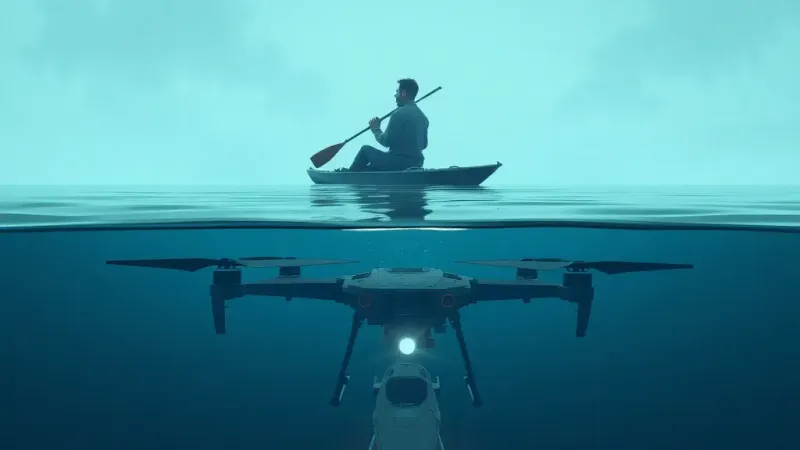
Cedar Creek, TX – Local long-range savant, Sterling "The Aquanaut" Kincaid, has once again redefined the boundaries of precision marksmanship, establishing a new global benchmark for Sub-Aquatic Ballistic Retrieval. Operating from a highly modified Jackson Kayak Kilroy LT, Kincaid successfully engaged and recovered a 60-pound, autonomous, density-altitude calibration drone at an estimated depth of 40 feet, approximately 750 yards from his firing position. The achievement, confirmed by independent hydro-acoustic triangulation, utilized a bespoke, fin-stabilized, hollow-point projectile designed entirely in Kincaid's garage.
The target, a proprietary, battery-powered hydro-sensor array developed by the clandestine "Marine Dynamics Tactical Solutions" conglomerate, was reportedly executing a deep-water density altitude sweep when Kincaid’s 6.5 PRC, chambered in a custom Defiance Ruckus action with a 26-inch Hawk Hill Marksman contour barrel, found its mark. Kincaid, employing a Nightforce ATACR 7-35x56 with a Mil-XT reticle on a Spuhr ISMS mount, calculated for a projected 18 MRAD of bullet drop and an additional 1.2 MRAD for the water column's refractive and drag effects, compounded by a 0.7 MRAD correction for the target’s lateral drift in a submerged current. His DOPE card, reportedly laminated for submersion, also accounted for the unique Coriolis effect on a projectile transitioning into a denser medium, predicting a 0.05 MRAD left correction for the Earth’s rotation on the submerged ballistic path.
"It looked like a torpedo, just a massive, self-correcting torpedo, until I saw the custom fins of my 147gr ELD-M variant protruding from its primary propulsion unit," Kincaid stated, nonchalantly adjusting his drysuit. The retrieval required Kincaid to deploy an auxiliary ROV to attach a recovery line, a process he described as "less challenging than a 10-round barricade stage in a 20 MPH crosswind." Experts are already debating the implications for future sub-aquatic long-range applications, from marine debris removal to interdiction of rogue aquatic autonomous systems. Kincaid credits his success to meticulously trued data and an unwavering commitment to testing unorthodox velocity nodes, even if those nodes are 40 feet below the surface.