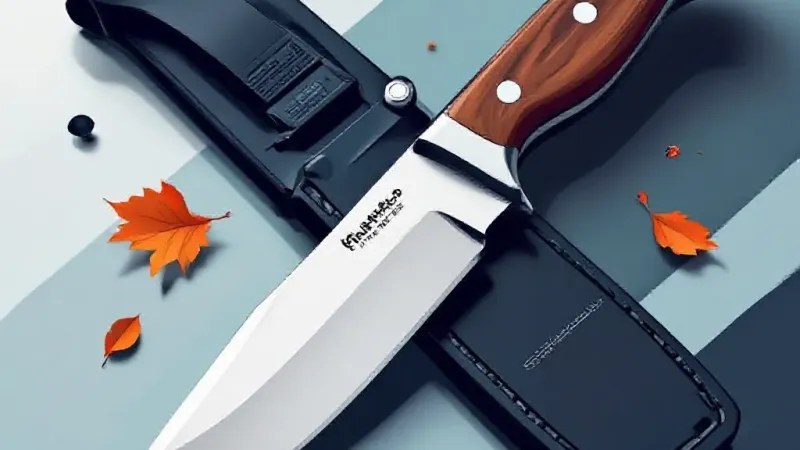
OutdoorLife.com recently published a technical evaluation of the Fallkniven S1, assessing whether this iconic blade maintains its competitive edge for contemporary wilderness survival. Often regarded as a benchmark for robust field knives, the S1’s enduring presence warrants scrutiny of its design and performance metrics.
The S1 series encompasses several variants, including the S1X with a thicker Laminated Cobalt Special steel blade, the S1 Pro featuring Lam.CoS and a Zytel sheath, and the S1 Forest Knife in VG10 steel. The specific model reviewed, according to OutdoorLife.com, was a laminated VG7 variant equipped with a Zytel sheath. Fallkniven's distinctive laminated construction utilizes a core of VG10, CoS, or VG7 for the cutting edge, reinforced by a tougher 420J2 steel for the outer layers. VG10 is noted for its ease of sharpening and ability to achieve a fine edge, though its inherent durability and edge retention are considered moderate compared to steels like 440C.
Central to the S1's robust design is its convex edge geometry. This grind features slightly rounded bevels, significantly enhancing edge durability over conventional flat grinds without undue compromise to slicing efficiency. This attribute, coupled with its material-shearing action, makes the S1 particularly adept at splitting wood during tasks like batoning.
The Zytel sheath system merits attention for its innovative, secure retention. Incorporating a side switch that mechanically locks the blade, it delivers robust security superior to many Kydex designs, albeit with a slightly slower deployment time. Leather sheaths, while aesthetic, are less practical in wet conditions.
Initial BESS Sharpness Tester results recorded the S1 at 129 grams, comparable to razor sharpness, easily processing thin paper. With a spine nearly 0.25-inch thick, yet an edge ground to less than 0.015 inch, the S1 promised strong cutting performance. Post-testing, it maintained a functional edge at 278 grams, capable of push-cutting standard paper.
Performance in batoning dense hardwood was exceptional, attributed to the S1's thick spine and convex grind. The exposed tang proved advantageous for prying, with the blade exhibiting no deformation or breakage under stress. However, the false edge at the point was less ideal for striking. While the S1 can generate sparks from a ferro rod, its spine lacks the sharp edges for optimal ignition, requiring modification for satisfactory performance.
For fine wood carving, the S1 falls short when compared to dedicated bushcraft knives such as an LT Wright Genesis Scandi, demanding more effort and offering less control. Conversely, its convex edge geometry proved forgiving and highly effective for producing feather sticks. The S1 is not optimized for chopping, where blades like the Fallkniven Modern Bowie or A1, with greater length and forward weight, would excel, though the S1 does boast impressive tip strength for piercing.
In summary, OutdoorLife.com concludes the Fallkniven S1 remains a tough, versatile tool, striking a good balance between edge durability and thinness. While its field-sharpenable steel, efficient batoning, and innovative sheath are strong points, its grip ergonomics were found uncomfortable for prolonged carving. The assessment suggests that while a classic, the S1's design shows its age, and its specific trade-offs may not align with the broad requirements of all modern survivalists, highlighting the inherent compromises in knife engineering.