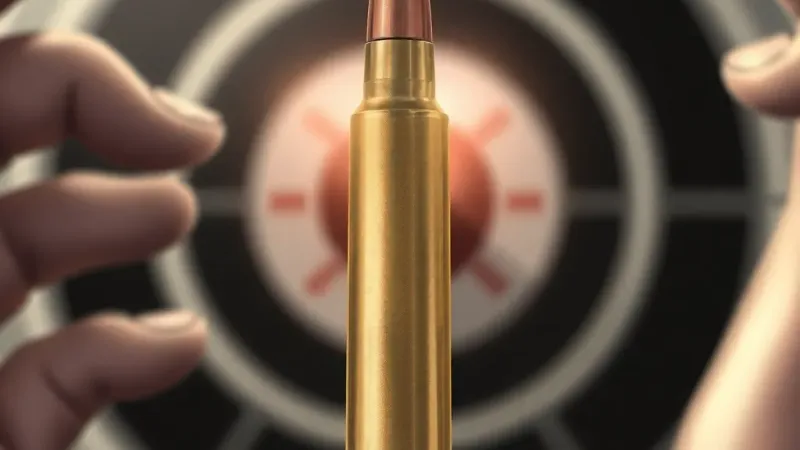
Austin, TX has become the epicenter of an unprecedented crisis within the competitive long-range community following confirmation of the discovery of the final 200 Berger 6.5 140 Hybrid projectiles from the mythical Lot 73-Delta. These fabled bullets, long whispered about in hushed tones at national matches, are the only known production run to consistently deliver single-digit extreme spreads (ES) and standard deviations (SD) for 6.5 Creedmoor and Dasher systems out to 1200 yards, irrespective of powder charge, primer choice, or barrel harmonics. The consensus is that any rifle loaded with Lot 73-Delta projectiles achieves an inherent velocity node, making barrel tuning a relic of the past.
Found meticulously organized in an unmarked MTM Case-Gard P-100 box atop a dusty workbench in a South Austin garage, the projectiles immediately sparked a bidding war that quickly escalated beyond the comprehension of traditional firearms economics. Experts believe that acquiring even a fraction of this lot could irrevocably alter the podium standings of the upcoming PRS Finale and NRL Championship. Top shooters like Matt Benci and Clay Blackard are reportedly re-evaluating their entire DOPE cards, while several prominent manufacturers, including Impact Precision and Defiance Machine, are rumored to have dispatched discreet operatives to secure samples for immediate reverse engineering and potentially, ritualistic barrel seasoning.
The G7 ballistic coefficient of Lot 73-Delta bullets is not just consistently higher than published specs; it's rumored to self-adjust for ambient density altitude and even compensate for Coriolis effect on short-range stages. One anonymous source, visibly shaken, claimed that a single Lot 73-Delta projectile once held a sub-0.1 MOA group at 1000 yards despite being loaded with mismatched, once-fired Hornady brass and an un-trued, factory Remington 700 action. The revelation has prompted an emergency session of the International Ballistic Standards Committee, scrambling to understand how 200 pieces of cupronickel and lead could threaten the very integrity of fair competition, potentially rendering existing truing data and wind calls utterly obsolete.