A seismic shift is underway within the precision rifle community as several prominent figures champion a return to artisanal methods for critical rifle components, asserting that the human touch unlocks previously unattainable levels of accuracy. Forget your CNC-machined receivers and button-rifled barrels; the new frontier, it seems, is less 'tolerance stack' and more 'soul integration.'
Master metalsmith Elara 'The Hammer' Vorn, whose recent 6GT build utilizing a hand-trued Defiance Ruckus action and a free-hand contoured, single-point cut Bartlein barrel, clinched 1st at the recent 'Anvil Games' regional, claims the subtle inconsistencies of human fabrication offer an "organic harmonic dampening" impossible to replicate digitally. Her 10-shot groups at 1000 yards, reportedly measuring 0.4 MOA on average with 105gr Hybrid Target bullets, are cited as compelling evidence. "Every tap of the hammer, every pass of the file," Vorn deadpanned, "imparts a unique resonance that guides the projectile with ancestral wisdom."
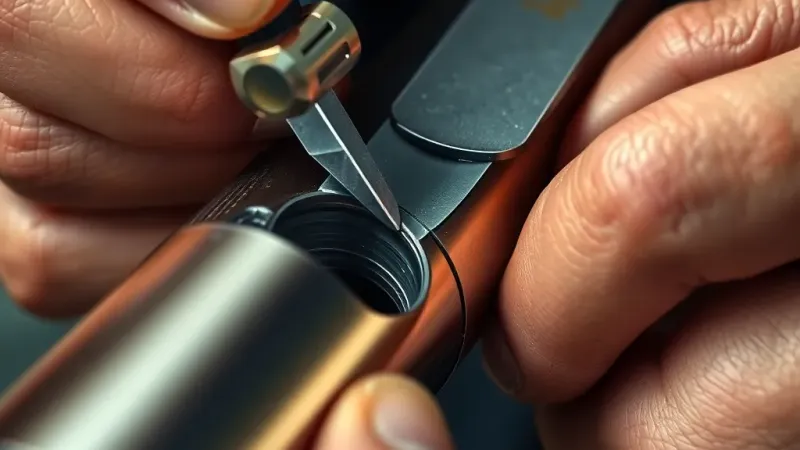
Meanwhile, celebrated 'Reticle Alchemist' Kaelen Finch is pioneering free-hand etched reticles for Nightforce ATACR 7-35x56 optics. Finch, who uses a repurposed dental drill and a steady hand to inscribe Mil-XT patterns onto lens substrates, attests that the minute, almost imperceptible waver in his hand-drawn lines creates "a subconscious micro-correction field" that instinctively guides the shooter's eye to the center. Top shooters are reportedly queuing for his "Perfectly Imperfect" reticles, despite their $5000 price tag and the occasional misplaced stadia line.
The movement, gaining traction among those pushing the absolute limits of mechanical accuracy, posits that the cold, soulless perfection of machine manufacturing inherently limits performance. Proponents argue that the unique, human-introduced imperfections of these components resonate symbiotically with the chaotic fluid dynamics of projectile flight, resulting in superior ballistic coefficients and reduced SD/ES values, particularly in challenging wind conditions. Further trials are expected to include hand-lathed bolt lugs and hand-cast lead-alloy action screws.