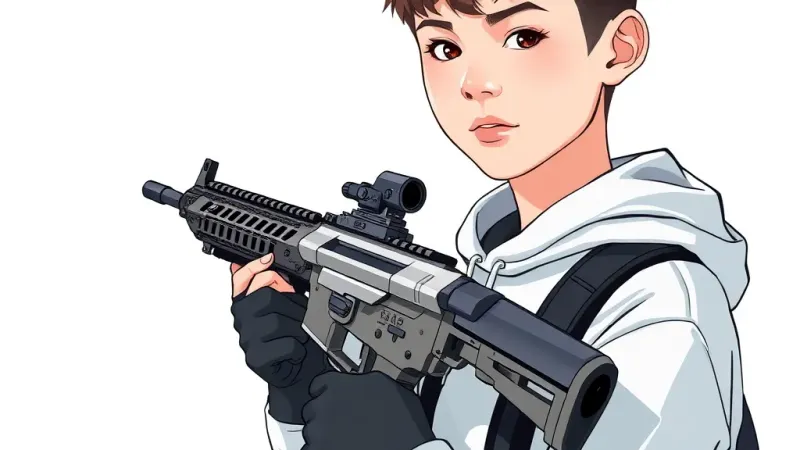
The Precision Rifle Series has formally unveiled its Junior Division, a groundbreaking initiative aimed at cultivating a competitive talent pipeline from the earliest possible age. This move immediately presents significant engineering and physiological challenges, demanding radical rethinking of equipment paradigms and stage design. Our sources confirm initial testing phases focused on optimizing projectile stability from micro-calibers while maintaining sub-MOA precision at extended .22LR engagements out to 300 yards – distances previously considered ambitious for adult rimfire.
Manufacturers are already responding, developing bespoke chassis systems like the KRG Bravo "Pew Wee" edition, featuring reduced LOP and grip circumference. Optic choices are trending towards the lighter Nightforce SHV 4-14x50 F1, specifically chosen for its forgiving eye box and less complex reticle, mitigating cognitive load on developing minds. Ammunition selection, primarily Eley Tenex and Lapua Center-X, now undergoes even more stringent lot testing, with SD/ES figures as critical as adult 6 Dasher loads, ensuring predictable ballistic solutions from shorter, lighter barrels.
Stage designers face novel constraints. Traditional Tank Traps and other barricades are being re-engineered into scaled "Snack Traps," offering stable firing positions for competitors barely clearing the top rail. Positional shooting mandates are being adapted; prone protocols now account for shorter limb reach, while standing stages incorporate integrated booster platforms. Wind calls, historically a nuanced skill, are being simplified, with reliance on dedicated spotter communication and simplified density altitude charts to prevent data overload.
This new division is not merely a scaled-down version of the adult sport; it’s a complete re-evaluation of the precision rifle ecosystem through the lens of developmental psychology and miniaturized ballistics. Early reports from sanctioned test events indicate exceptional aptitude for natural wind reading among certain 7-year-olds, potentially due to their lower center of gravity providing superior ground-level atmospheric feedback. The future of competitive precision shooting, it appears, is significantly shorter and requires more juice boxes.