
The recent PRS Lone Star Challenge at TX Precision proved to be a crucible of skill, crowning John "Apex" Miller as the champion in a field of seasoned competitors. Held over two grueling days under relentless, shifting winds, this match was a true test of external ballistics mastery and mental fortitude. With 18 stages meticulously designed to exploit any weakness, and elevations ranging from 700 to 900 feet ASL, temperatures fluctuating between 55 and 70 degrees Fahrenheit, competitors faced the full spectrum of Texas weather challenges.
The defining characteristic of the match was undoubtedly the wind. Sustained at 15-25 MPH with gusts pushing 30 MPH, often switching direction by as much as 90 degrees between impacts, accurate wind calls were paramount. Many stages featured multiple targets at varying distances, demanding quick adjustments to DOPE and hold. Shooters relying solely on their Kestrel 5700 Elite data without proper observation paid a steep price. Understanding the subtle shifts in mirage and foliage movement became as critical as knowing your true muzzle velocity and trued ballistic coefficient. Spin drift and Coriolis, while always present, took a backseat to the immediate challenge of reading the brutal crosswinds on targets out to 1200 yards.
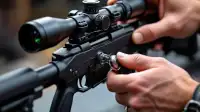
Stage 9, "The Rattler's Perch," exemplified the match’s difficulty. Competitors engaged six steel targets from various positional prone and supported standing barricade positions, ranging from 400 to 950 yards, all while dealing with a swirling headwind-to-crosswind transition. The requirement for quick barricade technique transitions and rock-solid positional stability under pressure separated those who merely shot accurately from those who truly mastered the environment. Miller's clean run on this stage, utilizing his Impact Precision action, Bartlein M24 contour barrel chambered in 6 Dasher, and Nightforce ATACR 7-35x56 with the Mil-XT reticle, was a masterclass in controlled aggression.
A common thread among the top finishers was meticulous data management. Shooters had detailed DOPE cards for multiple wind conditions, leveraging well-understood velocity nodes for their handloads, typically running 105-112gr Berger Hybrids or similar high-BC projectiles. Their commitment to confirming cold bore shots and truing their ballistic data out to maximum effective range was evident in their first-round hit percentages. The difference between 1st and 5th place often came down to one or two dropped points from a single missed wind call or a momentary lapse in positional stability. This match highlighted that even the most advanced gear, such as an MPA Matrix chassis, is only as good as the shooter's ability to interpret and react to the environment.
The Lone Star Challenge was not just a competition; it was an education. It underscored that while a well-built rifle and precision ammunition are non-negotiable, it is the shooter's ability to process dynamic conditions, make intelligent wind calls, and execute fundamentals flawlessly under immense pressure that ultimately determines success. Congratulations to John Miller for a truly dominant performance in a match that will be remembered for its demanding conditions.