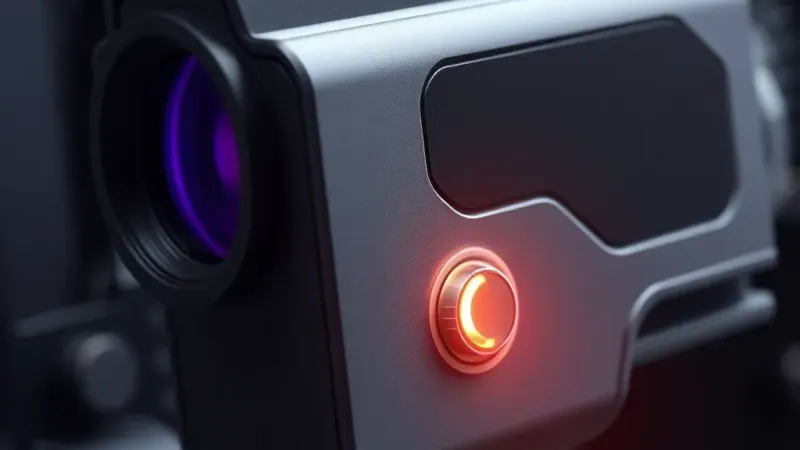
The competitive long-range precision shooting community finds itself at a new, contentious crossroad: the proposed integration of manual safeties onto critical ranging devices. What began as whispers following the 2023 PRS Finale has escalated into a full-blown doctrinal schism among top-tier shooters and gear manufacturers. The central tenet of this radical proposal, championed by the newly formed Institute for Proactive Ranging Security (IPRS), is to mitigate "premature laser emission" – the accidental ranging of non-target areas or, worse, unintended target illumination prior to stage commencement.
Proponents argue that a simple, positive-engagement manual safety, akin to a traditional firearm safety, integrated into units like the Vectronix Terrapin X or the Vortex Razor HD 4000, would eliminate the risk of inadvertent ranging during barricade transitions or while confirming spotter DOPE. "The last thing you need when trying to true your ballistic calculator with a fresh set of chronographed SD/ES data is an accidental 1.3 MOA ranging error because your thumb brushed the acquire button while moving to position four," states IPRS director Dr. Silas Greentree, known for his work on barrel harmonic dampeners.
Opponents, a formidable bloc including numerous past national champions, decry the proposal as an unnecessary complication, citing potential for fumbled engagement and critical delays. "In a tight stage requiring rapid acquisition of targets from 500 to 1200 yards under varying density altitude, adding another physical manipulation is a non-starter," argues multi-time champion Rhys 'The Hammer' Kincaid. "My Kestrel 5700 Elite already needs a positive button press to cycle data, and the risk of a mis-ranged shot due to a fumbled safety disengagement outweighs any perceived benefit of preventing an accidental ranging of, say, a passing squirrel." They highlight that a well-practiced draw and depress action is already ingrained, and any additional step impacts critical split times and the ability to rapidly confirm cold bore data.
The debate rages on, with custom builders already prototyping solutions. Whether the pursuit of preventing accidental ranging errors justifies the added complexity and potential for operational failure remains the most pressing question facing precision riflemen this season.