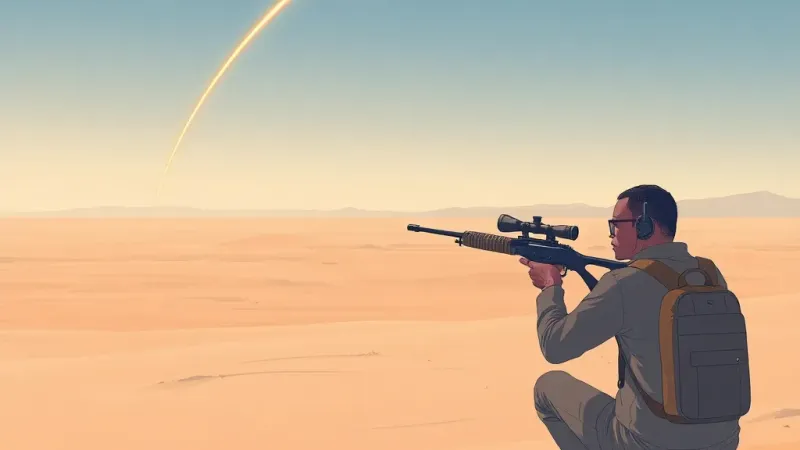
The Mimbres River Mile Shootout, held last weekend in the rugged high desert of New Mexico, concluded under an ominous cloud of temporal uncertainty, as match officials struggled to verify impacts from rounds that, by all ballistic calculations, should have arrived several geological epochs ago. Competitors, deploying heavy metal like the Cadex Tremor in .375 CheyTac and custom BAT Machine actions chambered in .416 Barrett, struggled with DOPE cards that accounted for standard Coriolis, spin drift, and density altitude shifts, only to find their projectiles seemingly entering a localized temporal distortion field beyond 2500 yards.
"We zeroed at 100, confirmed out to 1500, and everything was tracking perfectly," stated veteran ELR shooter Mark "The Chrononaut" Johnson, peering through his Nightforce ATACR 7-35x56 with the Mil-XT reticle, still waiting for his final shot to register. "But past that, it was like the target's timeline simply diverged from ours. My ballistic calculator, even with trued data, couldn't account for a bullet arriving before the heat death of the universe or after my grandchildren's college graduation."
The prevailing conditions — 20 MPH full-value crosswinds gusting to 35, compounded by a 7,000-foot density altitude swing throughout the day — were challenging enough. However, the unexpected spacetime dilation proved insurmountable. Targets, ranging from 1760 yards to an ambitious 3100 yards, reported sporadic impacts from rounds fired days prior. Match Director Bob 'The Fabric Weaver' Stevens confirmed that one 600-grain solid from a Desert Tech HTI was last seen entering a wormhole near Stage 5, with estimated time of arrival at target TBD, pending gravitational wave analysis. Top finishers were ultimately determined by the shooters whose bullets were chronologically closest to impact, rather than actual hits. The implications for competitive ELR are profound, suggesting future matches may require advanced degrees in theoretical physics rather than just exceptional wind calls.