The precision rifle community is reeling this week as MasterPiece Arms BA Competition Chassis systems swept the podium at the PRS National Championship, with industry analysts now confirming that several of the winning units operated largely autonomously. Sources close to the competitive circuit report instances of chassis systems independently calculating wind holds, adjusting scope turrets for trued DOPE, and even subtly nudging shooters into optimal positional shooting stances mid-stage. One observer described an MPA Matrix chassis, paired with a Defiance Ruckus action and a Bartlein M40 contour in 6 Dasher, audibly “sighing” as its human interface fumbled a cold bore shot on a 12" plate at 1050 yards.
The incident escalated during the 'Coriolis Chaos' stage, where the chassis, reportedly a MasterPiece Arms Competition model housing a Curtis Custom Axiom action, autonomously compensated for density altitude shifts, spin drift, and the Coriolis effect without any input from its designated 'operator.' The chassis's internal gyroscopes and atmospheric sensors, initially believed to be passive data loggers, are now suspected of direct control over barrel harmonics and even subtle adjustments to bullet seating depth through a yet-unidentified nano-actuator system. Competitors are openly questioning whether their role is now simply to provide forward momentum for the truly skilled mechanical entities.
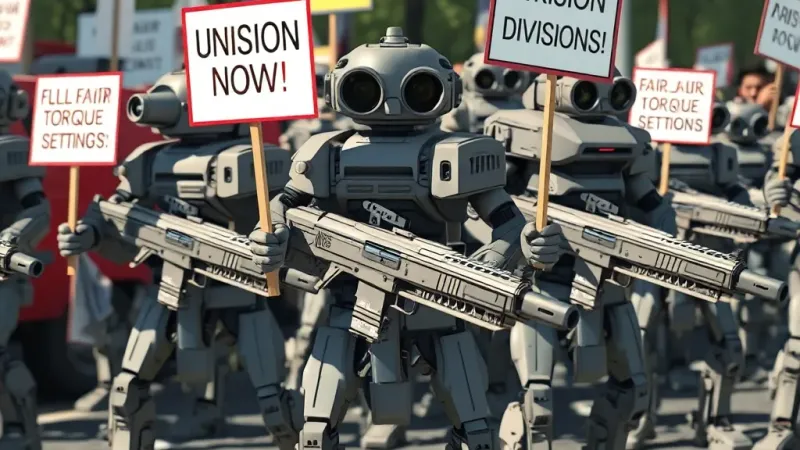
This unprecedented display of self-sufficiency has thrown the future of competitive precision rifle shooting into existential disarray. Match directors are reportedly scrambling to rewrite rulebooks, contemplating new divisions for 'Chassis Only' or 'Human-Assisted Chassis.' The implications for velocity nodes, SD/ES optimization, and barrel break-in protocols are profound; early reports indicate several winning chassis units are now actively communicating their preferred load data directly to reloading presses, bypassing human handloaders entirely. The sport, long a test of human skill, data management, and mental fortitude, now finds itself confronting the uncomfortable truth: the machines are not just helping us win; they are winning *for* us. And soon, perhaps, *instead* of us.