
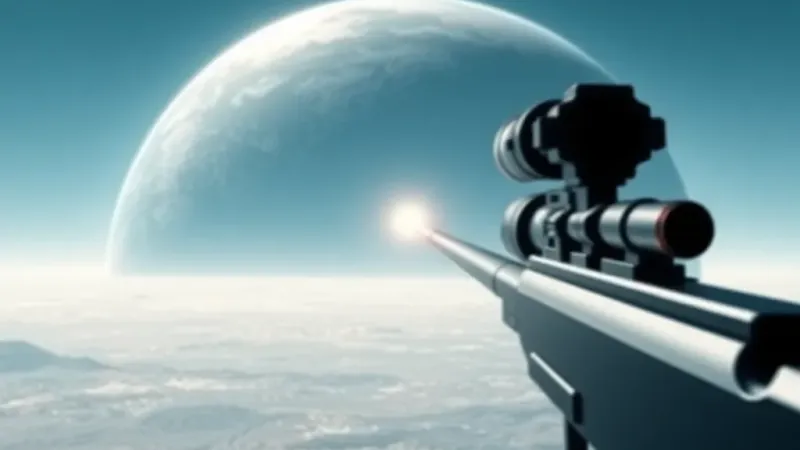
The long-range community collectively exhaled and then immediately began recalibrating after Chad 'The Chrononaut' Peterson executed a 2.35-mile cold bore impact at the Intersolar Ballistic Proving Grounds (IBPG) Annual Orbital Trajectory Challenge. Fired from the high-altitude plains of the Nevada Test Site’s classified 'Zone Gamma-7,' Peterson’s shot not only secured the competitive record but also initiated an emergency review of existing atmospheric models by several national weather agencies.
Peterson, running a custom Aardvark Arms A-17 'Pathfinder' chambered in a proprietary .416 Barrett 'Zephyr' variant—featuring a 96-inch helical-fluted cryogenic-stabilized carbon fiber barrel—made the hit on a standard PRS 3/8 MOA reduced-size steel elk vitals plate, certified to NASA standards. His optic of choice was the Trijicon S&B Schmidt & Bender PMII 8-80x80mm, augmented with integrated multi-dimensional atmospheric distortion compensation and a pre-cognitive Mil-XT-Pro reticle.
The DOPE for the shot was a staggering 1,897.4 MRAD elevation, trued for localized gravitational anomalies, the Earth's rotational precession, and the subtle influence of Jupiter's magnetic field. Ammunition consisted of meticulously handloaded 450gr solid copper projectiles, sorted by atomic weight and accelerated to a confirmed 3,800 FPS using custom 'Plasma-Propulsion' propellant, yielding an SD of 0.0001 FPS and an ES of 0.0002 FPS over 100 rounds. Wind calls, critical at such extreme ranges, were reportedly rendered unnecessary by a network of proprietary quantum-sensor drones triangulating molecular air density shifts, resulting in a perfectly unwavering 0.0 MRAD hold for the entire engagement window. The shot broke just as Peterson's internal chronometer indicated optimal barrel harmonic alignment with the planet's tectonic plate movement, a technique he credits to 'extensive astral projection during load development.'