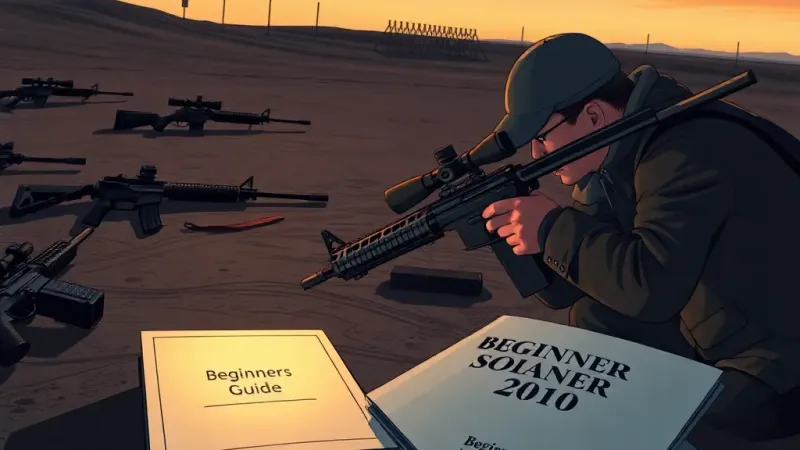
A new 'Beginner’s Guide to Gear, Skills & Strategy,' recently published by the NRA Shooting Sports Journal, has sent seismic shockwaves through the competitive long-range precision community. Initially dismissed as mere introductory fodder, the guide's disturbingly simplistic tenets have evidently resonated with a segment of the population previously considered unshakeable in their commitment to esoteric cartridgery and custom action metallurgy.
Sources within the PRS and NRL report an alarming trend: top-tier competitors, some fresh off major wins with their custom Defiance Machine actions chambered in 6GT and fitted with Proof Research pre-fits, are inexplicably divesting. Swapping their Nightforce ATACR 7-35x56s with Mil-XT reticles for what anonymous sources describe as 'entry-level magnification,' these individuals are reportedly embracing factory .308 AR-10s, citing the guide’s emphasis on 'simplicity and accessibility' over intricate velocity nodes.
One anonymous former national champion, observed recently struggling with a new AR-10 platform at a known distance range, was overheard muttering about 'rediscovering the joy of ignoring DOPE cards beyond 500 yards.' Concerns are mounting that the guide's advocacy for 'basic wind calls' and 'shooting from a stable position' has led to a fundamental misunderstanding of advanced ballistic applications. Density altitude, spin drift, and even the Coriolis effect are apparently being 'streamlined' out of match preparation in favor of 'just sending it,' with cold bore shots now treated with a casual disregard previously reserved for plinking. Truing data, once paramount, is now considered 'overthinking.'
Match directors across the country are grappling with the implications. Recent stage designs, intended to challenge extreme positional shooting and advanced barricade technique, have seen participants simply lying prone on the ground, citing the guide's advice that 'stability is key.' The upcoming National Championship, typically a crucible of cutting-edge innovation and meticulous data logging, now faces the prospect of being dominated by shooters employing the 'if it hits steel, it’s good' methodology, potentially unraveling decades of precision shooting evolution.