Reports from an obscure new ‘Olympic Match Rifle’ discipline are circulating, revealing a competition format that has left the precision rifle community scratching their heads. Unlike established long-range series where environmental truing and advanced ballistic computations are paramount, this nascent circuit apparently minimizes all variables that separate a true competitor from a novice.
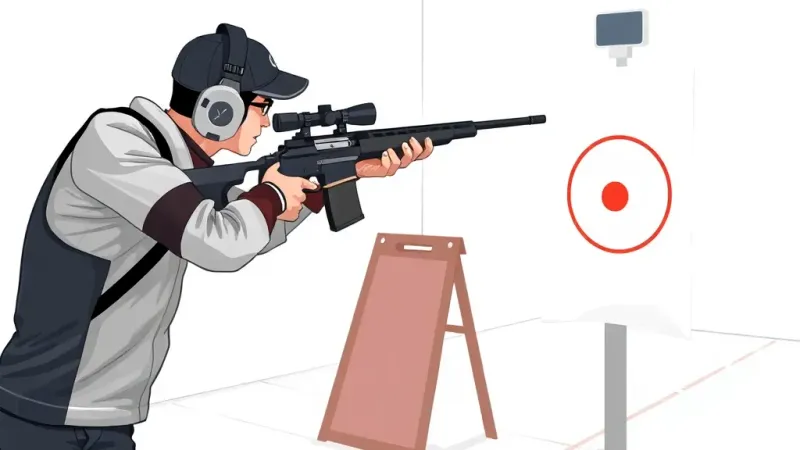
Initial intelligence indicates primary engagements are at an astonishingly short 50 meters, with some stages reportedly closer to 10 meters. Shooters are observed using what sources describe as ‘smallbore’ and ‘air rifles’ – devices notably devoid of heavy chassis systems, high-BC projectiles, or even muzzle brakes. The optic choices are equally perplexing, with competitors often running fixed-power scopes lacking the intricate reticles necessary for complex wind holds or precise elevation adjustments beyond 20 MILS. The Nightforce ATACR 7-35x56 or Kahles K525i, standard fare for discerning competitors, are conspicuous by their absence.
Match conditions are reportedly stable, indoor, and critically, entirely devoid of wind. Competitors are afforded ample time to establish stable positions, primarily standing, kneeling, or prone without the benefit of barricades or challenging terrain. Stages do not feature moving targets, varying target sizes, or unexpected engagements. DOPE cards, traditionally a roadmap for atmospheric changes and bullet flight, are considered superfluous. Competitors instead focus on ‘breath control’ and ‘trigger discipline’ – foundational concepts, certainly, but only a fraction of the skillset required to break PRS top 10.
The scoring system, a baffling decimal-point methodology, awards points for centering shots on a static paper target. The crucial absence of spin drift, Coriolis effect, or even simple density altitude calculations suggests a format tailored for an entirely different kind of 'precision.' While intriguing, the 'Olympic Match Rifle' discipline offers little in the way of transferable skills for serious long-range competition, save perhaps a heightened appreciation for the complex realities of an actual match stage.