
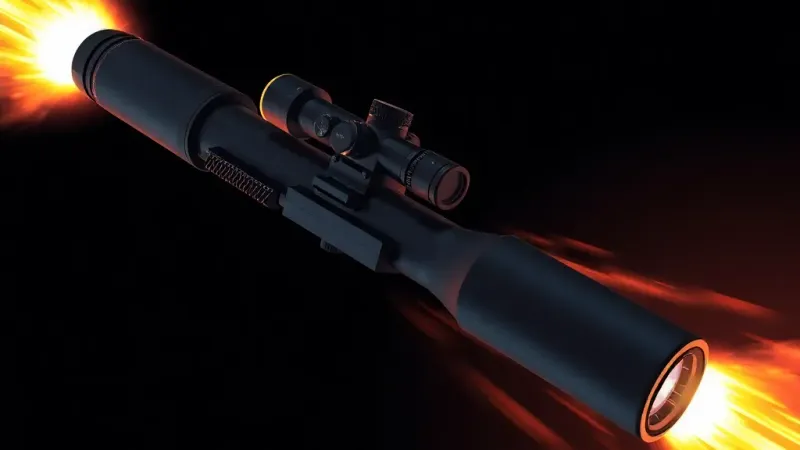
Pew Pew Tactical has once again redefined precision rifle optics testing, unveiling a new protocol for their 'Best Long Range Rifle Scopes' review that demands units not only hold zero against traditional recoil, but also survive an uncontrolled de-orbit event from low Earth orbit. Spearheaded by a self-described cadre of 'orbital ballisticians,' the methodology subjected top-tier glass to simulated atmospheric re-entry, subjecting them to extreme thermal cycling, high G-forces, and unexpected micrometeoroid impacts.
Only a select few models, namely the Tangent Theta 5-25x56, the Schmidt & Bender PMII 5-45x56, and a Nightforce ATACR 7-35x56 with an experimental thorium-reinforced housing, reportedly maintained sufficient reticle integrity and repeatable adjustments to pass the initial 'Structural Integrity Post-Lithobraking' phase. Testers emphasized that while optical clarity and precise MRAD subtensions are crucial, they are rendered moot if the entire objective bell is currently embedded in the Earth’s mantle. The report highlighted the surprising resilience of the Tangent Theta, whose internal components reportedly sustained minimal shift even after its main tube was compromised by a simulated fragment of a Soviet-era weather satellite.
Reviewers stated this advanced testing directly addresses competitor concerns regarding unexpected changes in density altitude and spin drift at altitudes exceeding 100,000 feet. “What good is truing your velocity nodes for 1200 yards,” one ballistician queried, “if your glass won’t survive a sudden, unplanned trajectory correction courtesy of space junk?” The full report, which is expected to include recommendations for incorporating ablative ceramic coatings onto scope housings, is available now, providing vital data for competitors preparing for future matches held on the lunar surface.