The evolution of modern line materials has transformed angling, with braided and super lines largely superseding monofilament for main spool applications over the past quarter-century. While monofilament and fluorocarbon retain their critical role as leader materials, the integrity of the braid-to-leader connection remains a subject of intense debate among serious practitioners. Many knots have vied for supremacy—the uni-to-uni splice, the double uni, the Alberto, Seaguar, and Bristol knots all offer functional performance after extensive laboratory and field testing. However, the FG knot stands alone in its demonstrated shear strength and unwavering reliability, effectively outperforming its predecessors.
Originating in Japan, the FG, short for "fine grip," found its initial popular adoption not among its inventors, but through Australian anglers. These practitioners, often casting from elevated positions, required a connection that could both traverse spinning rod guides with minimal friction for maximum casting distance and withstand the immense forces exerted by formidable pelagic species such as giant trevally and dogtooth tuna. The FG knot quickly proved its mettle under such punishing conditions.
Aesthetically, a perfectly tied FG knot is a testament to precision, though the learning curve can be steep, often yielding initial attempts that fall short of perfection. Widely acknowledged as challenging to tie, it holds a reputation akin to the Bimini Twist for a new generation of users—mastering it efficiently is a mark of significant skill. Initial attempts may instill doubt regarding its efficacy, but proficiency quickly builds confidence, leading to steadfast reliance.
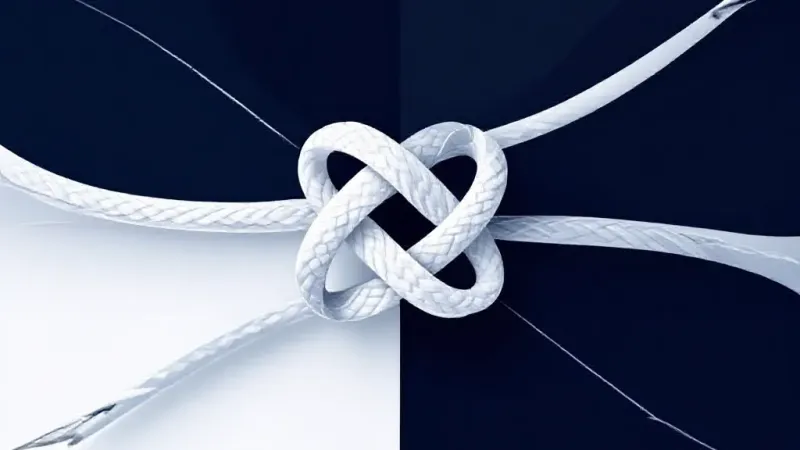
Unlike conventional knots that depend on the jamming of two separate structures or the cinching of coils, the FG knot employs a unique plaiting mechanism. To execute, firmly secure the rod, maintaining significant tension on the braid by holding its end in your teeth and moving away from the rod. Position the leader perpendicular to the taut braid. Systematically pass the leader end under the braid, first moving away, then pulling tight, followed by passing it under the braid moving toward you, pulling tight. This alternating sequence is repeated 20 times. Upon completion, secure the plaited section by tying a single overhand knot with the braid tag end around the leader.
This plaiting action creates a mechanical advantage akin to a Chinese finger trap; as tension increases from a pulling fish, the plaited braid progressively tightens its grip on the thicker leader. Once initial pressure has been applied to set the plaiting firmly, proceed by adding 10 to 12 half hitches around the leader using the braid tag end. Both tag ends can then be trimmed flush. While a small drop of super glue may be applied to the half hitches for added security, it is crucial never to apply adhesive to the plaited section itself.
Though conceived for battling large saltwater game, the FG knot's superior characteristics translate to nearly all applications. While it requires more time than simpler splices, its inherent strength justifies the investment, even for lighter tasks such as trout or schoolie striper fishing. Elite Series bass professional Carl Jocumsen is a strong proponent, employing the FG almost exclusively. Jocumsen highlights its slender profile, which permits reeling the knot directly onto the spool of even low-profile baitcasters, enabling the use of longer leaders—ten feet or more—without compromising castability. He views it as an "added insurance policy when tournament money is on the line." Jocumsen states, "The FG is so strong that I never worry about the connection breaking anymore." He prioritizes concerns about hook or braid failure over the knot itself, asserting that a split ring would likely fail first. Personal experience further validates this, with the knot surviving instances where 60-pound braid snapped or belly hooks were torn from snagged plugs.