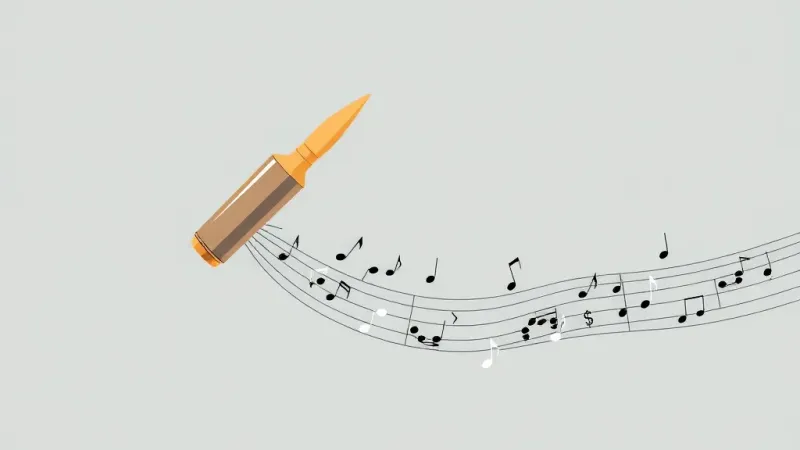
The competitive precision rifle world was rocked this week by an unprecedented announcement from PRS-M (Precision Rifle Series – Music), a previously obscure entity that has suddenly asserted intellectual property claims over the acoustic signatures of ballistic trajectories. Effective immediately, every projectile sent downrange—from a 6mm ARC out of a Curtis Custom Axiom action to a .300 PRC barking from a Zermatt Arms Origin—will be subject to a per-shot royalty.
PRS-M, formerly concerned with sync rights for elevator music, now classifies the entire ballistic event, from the initial pressure wave of the muzzle brake to the supersonic crack and terminal impact on AR500 steel, as a "sonic composition." This mandate extends beyond the initial "performance" of the muzzle blast. The Doppler effect of the bullet, its harmonic interaction with atmospheric density changes, and even the subtle "thwack" of a Berger 105 Hybrid impacting AR500 steel at 1200 yards are now classified as monetizable "audio events."
Match directors are reportedly installing sensitive acoustic transducers on stages, mandated to log and report each "performance." This new financial burden is estimated to add between $5 to $15 per stage for an average 10-round engagement, pushing the true cost of a match weekend well into four figures before travel. Shooters are now tasked with updating DOPE cards to include ‘Performance Rights Royalties’ as a line item, alongside wind calls and Coriolis corrections.
One anonymous source close to a top 6 Dasher shooter suggested competitors might be forced to intentionally stage ‘unpublishable’ shot sequences—perhaps by engaging targets with a heavily suppressed .22LR at extreme angles, hoping the resulting ricochet isn't deemed a 'melodic phrase.' The move has sparked outrage, with many questioning whether their finely-tuned velocity nodes and harmonically balanced barrel vibrations now qualify as a commercial artistic expression or simply an act of fiscal self-destruction.