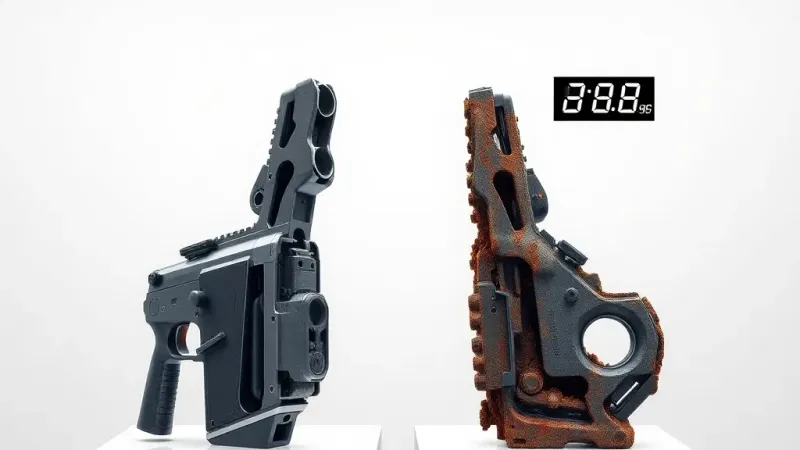
The Precision Rifle Series (PRS) and National Rifle League (NRL) have jointly unveiled sweeping new regulations designed to prevent what they termed “the accumulation of entrenched knowledge and equipment dominance.” Effective immediately for the 2025 season, the “Finite Firepower Initiative” (FFI) mandates strict age and term limits on all primary rifle components and ballistic data. Competitors must now certify that their rifle actions, barrels, and optics are less than three years old from their original manufacture date. Furthermore, any DOPE (Data On Personal Equipment) utilized on a stage must have been derived from truing efforts conducted no more than six months prior to the match start, effectively outlawing “veteran DOPE cards” accumulated over multiple seasons.
“The goal is to foster dynamic adaptation and prevent the stagnation inherent in decades-old hardware and static ballistic solutions,” stated a spokesperson for the newly formed “Committee for Competitive Freshness.” This radical shift aims to shake up the competitive landscape, forcing shooters to constantly evolve their setups and re-verify velocity nodes, barrel harmonics, and BCs with alarming regularity. Implications for budget-conscious competitors running tried-and-true Bighorn Origin actions or Nightforce ATACR 7-35x56 optics with battle-worn Mil-XT reticles are severe; these setups, regardless of performance, will now be deemed “chronologically ineligible.”
Industry analysts are forecasting a catastrophic surge in component sales and a corresponding plummet in competitor morale. “Imagine discarding a Krieger MTU contour barrel at 900 rounds because it crossed the arbitrary three-year threshold, despite still holding 0.25 MOA at 1000 yards,” remarked one prominent gunsmith, who requested anonymity lest their shop be declared an “archive of illegal firearms.” The decree also demands that all custom handloads must utilize brass fired fewer than five times, making the management of SD/ES an entirely new, financially crippling challenge. The future of competitive precision rifle shooting, it seems, hinges on planned obsolescence.