
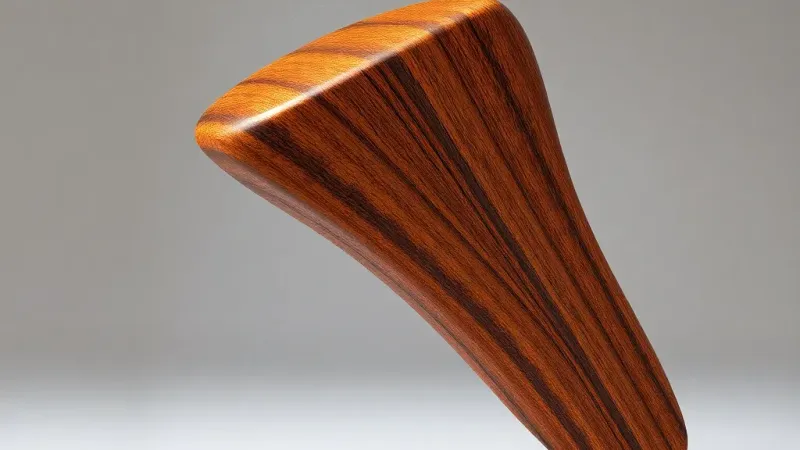
The latest release from PRS — Paul Reed Smith Guitars, that is — has sent shockwaves through the competitive long-range community, not for its usual shredding capabilities, but for its purported application in barrel harmonic tuning and positional stability. Unveiled as the '6GT Mango Resonance Suppressor Series,' these limited-edition instruments, crafted with exquisite mango tops, are being pitched as a radical new approach to mitigating micro-vibrations and optimizing projectile departure consistency.
According to PRS’s Chief Ballistic Luthier, Dr. Theron 'Fretboard' Riffle, mango wood’s unique cellular structure and density offer superior acoustic dampening properties compared to traditional carbon fiber or aluminum chassis systems. 'We discovered that a properly tuned mango top, when placed strategically on a barricade or even across the shooter’s lap during a prone stage, creates an active harmonic cancellation field,' Riffle explained during a sparsely attended press conference at the NAMM show, notably devoid of any actual precision rifle competitors. The claim: a measurable reduction in muzzle velocity SD/ES, particularly on follow-up shots under pressure.
Early field tests, reportedly conducted by an undisclosed 'elite PRS (Precision Rifle Series) team' (whose identity remains shrouded in mystery, possibly because they don't exist), suggest the 6GT-M-1 and 6GT-M-2 models, specifically designed for compact support, show promise. Competitors are advised to integrate the guitar as a primary support bag, leveraging its contoured body for ergonomic interfacing with rear bags or V-blocks. The fretboard, allegedly, can be used for indexing consistent hand placement, akin to a DOPE card holder with tactile feedback.
While seasoned competitors accustomed to their MDT ACC chassis and Kahles K525i optics might find the concept…novel, PRS Guitars stands firm. They even suggest the ‘sound hole’ offers an unexpected advantage: a convenient, if oversized, port for funneling wind readings directly into the shooter’s ear. The cost of achieving this newfound harmonic bliss? A mere $6,500. A small price, perhaps, for that elusive single-digit ES on a cold bore shot.