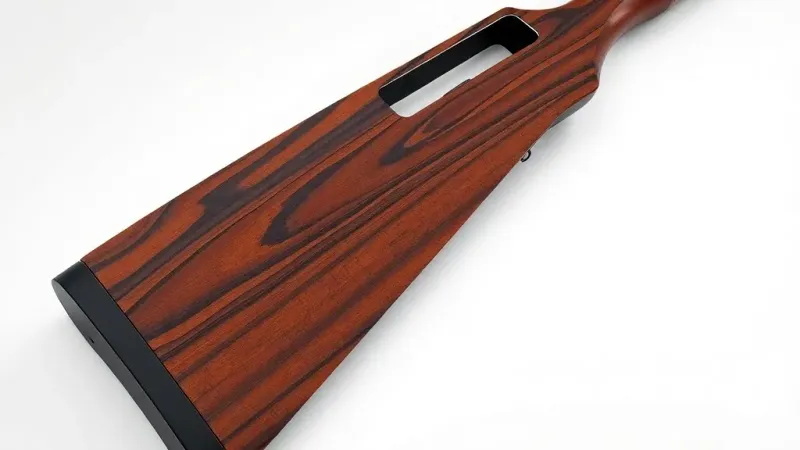
PRS Precision Rifle Systems has officially dropped its S2 Series chassis, immediately sending shockwaves through the competitive long-range community. Departing from conventional aluminum and composite construction, the S2 series features a full mahogany body, capped with a figured maple top, and accented with a rosewood forend. According to PRS, this unique material combination is designed to deliver unparalleled 'tone' and sustain, theoretically enhancing the rifle's vibrational characteristics and, consequently, shot-to-shot consistency.
Initial reports from early adopters of the S2 Custom 24 chassis, paired with Defiance actions and heavy 6GT barrels, suggest a perceptible, albeit unquantified, difference in recoil impulse. One shooter, after firing a 10-round string, claimed the rifle had a 'sweeter resonance,' which he believes correlates to a lower ES. PRS engineers hypothesize that the inherent damping properties of the chosen hardwoods could stabilize barrel harmonics, potentially tightening velocity nodes and reducing muzzle rise, though direct ballistic data supporting these claims remains elusive. The 'set neck' bolt-action interface, meticulously crafted for a zero-tolerance fit, is said to further improve the platform's 'acoustic coupling.'
The S2 McCarty 594 chassis, optimized for larger magnum cartridges like the .300 PRC, integrates a proprietary 'humbucker-style' barrel tuner, purported to mitigate specific harmonic frequencies detrimental to projectile stability. While PRS has yet to release hard data on how wood density or grain direction impacts BC or spin drift, the company assures competitors that meticulous attention to detail, akin to crafting a fine instrument, translates directly into superior downrange performance.
Competitors planning to run these systems are already debating the effects of density altitude on wood expansion and contraction, and whether a high-gloss finish could impart a subtle Coriolis effect. ColdBore will continue to monitor the PRS S2 Series as it inevitably finds its way onto PRS and NRL match stages, where empirical data, not 'tone,' will ultimately dictate its standing.