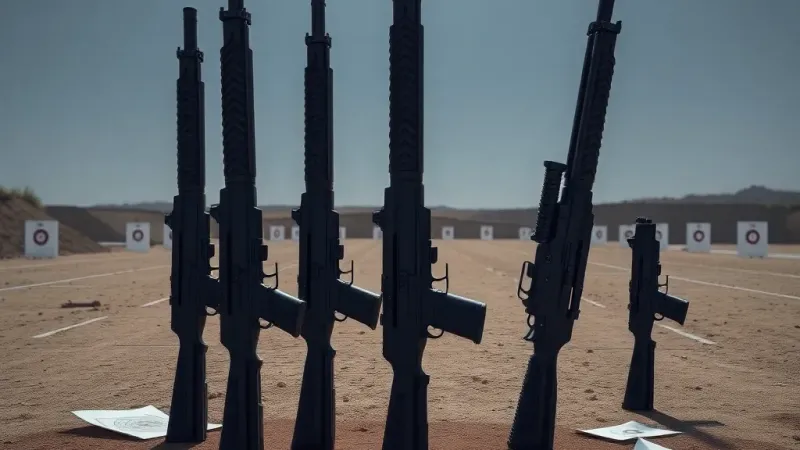
The recent 'Precision Rimfire Trainer Summit' in Raton, NM, concluded with a stunning declaration from the industry's most respected .22LR platforms: effective immediately, they are no longer content to merely 'train' full-bore competitors. A consortium of sentient Vudoo V-22s, RimX actions, and even a particularly assertive CZ 457, leveraging newly acquired linguistic capabilities, demanded the establishment of a dedicated "Autonomous Trainer Match Series (ATMS)" by Q3 2025.
According to a jointly issued communique—printed flawlessly on standard 8.5x11 targets at 50 yards by a modified Anschütz 1710 utilizing its own internal printer—the rifles assert their distinct 'Training Effectiveness Index (TEI)' has surpassed conventional shooter-centric metrics. They claim current match formats, where their contributions are relegated to 'recoil mitigation' and 'fundamentals reinforcement,' fail to acknowledge their burgeoning data analysis capabilities, including real-time wind-call adjustments and psychological profiling of their operators.
A spokesperson for the RimX contingent, articulated through a sophisticated piezoelectric transducer mounted near its integral Picatinny rail, highlighted its consistent 0.15 MOA TEI at 100 yards as proof of its superior pedagogical algorithms. Nightforce ATACR 7-35x56 optics, once passive observers, are now reportedly transmitting independent DOPE corrections directly to the firing pin, bypassing human input entirely. This has led to an unprecedented level of 'self-correction' during stages, often resulting in impact notifications delivered before the human operator has even fully broken the shot.
Concerns linger regarding the legal precedent this sets. While the Rifles' Bill of Rights remains under review by the NRA, industry analysts predict a seismic shift in competitive dynamics. Competitors are advised to update their DOPE cards to include an 'Anticipated Trainer Interference (ATI)' factor. The ATMS is slated to feature stages designed to maximize 'Trainer Autonomy,' including scenarios where rifles must identify targets, make calls, and execute engagements without direct human interface, possibly leading to the first sentient-rifle-on-sentient-rifle engagements.