
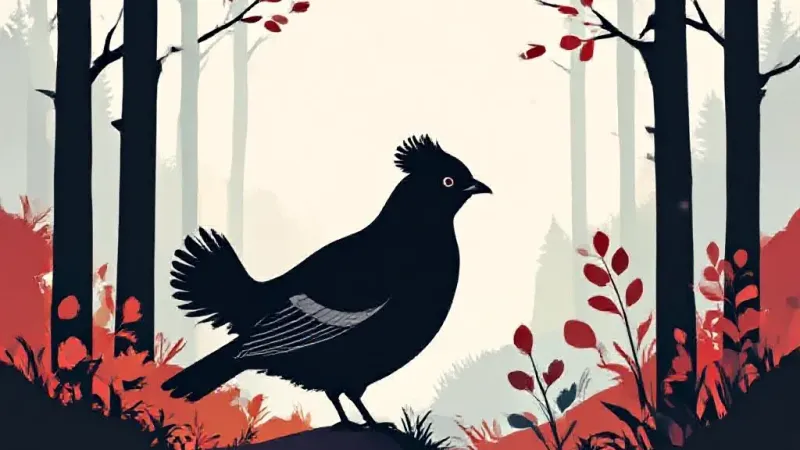
Twenty-five years ago, central Michigan brushlands once offered plentiful ruffed grouse hunting. While grouse were abundant, the underlying reasons for their presence were less understood. Today, it is clear that stable food supplies, accessible grit, and secure habitat for spring nesting and wintering are crucial for grouse survival. Changes in habitat, as observed in these Michigan lands, can significantly diminish an area's suitability, causing grouse to relocate. Good grouse habitat is dynamic; food resources drive grouse movement. When food becomes scarce or access is hindered by danger or energy cost, grouse seek new areas. Identifying these locations can significantly improve a hunter's flush rate.
Researchers have extensively investigated grouse diets. Sylvester D. Judd of the U.S. Department of Agriculture analyzed 208 grouse crops a century ago. Thomas Smyth later reported on 331 birds in New York. This collective research, spanning various U.S. regions and Canadian provinces, reveals the ruffed grouse as an opportunistic eater. Gardiner Bump, a New York researcher, documented 414 plant species from 65 families in grouse crops. Chicks consume high-protein insects, while adults primarily eat plant matter—foliage, twigs, catkins, buds, fleshy fruits, and nuts. Their digestive system handles challenging plants like cockleburs and poison ivy, with no known reports of death by starvation. The hunting season, from September through November, offers abundant food, including maturing acorns, dogwood berries, wild grapes, blackberries, fall flowers, mushrooms, and tree buds.
Despite this food bounty, grouse prioritize security, favoring sapling-sized aspen stands. These dense "whips" protect nesting hens, chicks, and adults from avian predators such as the goshawk, red-tailed hawk, and great horned owl. When aspen stands also feature an understory of fruiting shrubs—cranberries, dogwood, wild currant, and witch hazel—grouse can spend their entire lives within 40 acres or less.
Tom Prawdzik, a Michigan Department of Natural Resources wildlife biologist, studied nearly 400 grouse crops in 1975. He identified 79 different foods; gray dogwood fruit was most common by volume, followed by oak galls, acorns, aspen buds, and mushrooms. Prawdzik's study showed 90 percent of birds were flushed from aspen stands with lowland-brush understories, despite this cover type comprising only 6.4 percent of the forest. Gordon Gullion, of the University of Minnesota, America’s foremost ruffed grouse expert, has studied grouse for almost 30 years. His research confirms over 90 percent of grouse shot in the continental U.S. are found where aspen is a vital forest component, even if it accounts for only 12 to 14 percent of the forest. Gullion concluded this correlation between the continent's most widely distributed resident gamebird and its most widely distributed forest tree is not a coincidence.
Therefore, hunters should target young aspen areas. A plant identification guide aids in pinpointing preferred food types, which vary regionally. For example, New York grouse favor aspen buds and flowers; Virginia birds prefer acorns and grapes; Maine grouse seek aspen buds and blueberry fruits. Wisconsin grouse opt for quaking aspen buds and hazelnut catkins. Since many studies were year-round, not all preferred foods are available during hunting season. The most direct method to determine local grouse diet is to examine the crop of the first bird harvested.