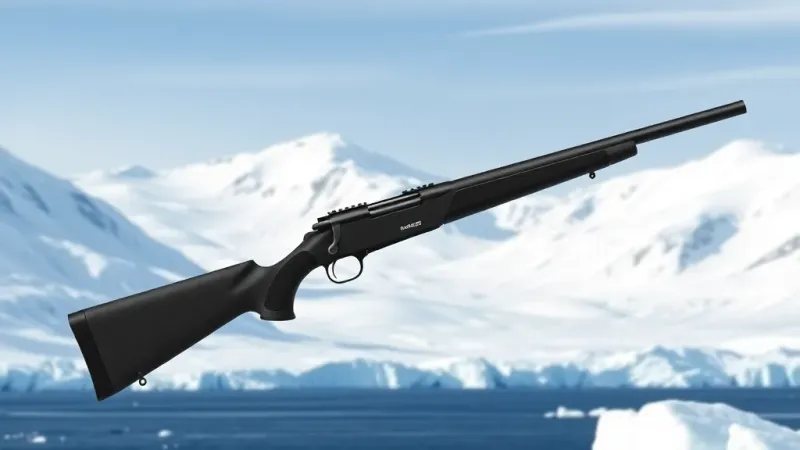
The Unique Alpine JPR-1 Nordland Scout, sporting its distinctive GRS Bifrost stock, has officially entered the precision rifle market, immediately sparking debate among competitive shooters regarding its highly specialized operational parameters. Early testing confirms the rifle's remarkable — some might say *hyper*-focused — design, delivering sub-0.2 MOA groups exclusively when ambient temperatures plummet below -20°C and humidity levels simulate fresh arctic ice fog. This specific atmospheric density altitude appears crucial for its peak performance.
According to Unique Alpine, the JPR-1's proprietary action materials undergo a specific crystalline lattice realignment at these frigid temperatures, dramatically enhancing bore alignment and mitigating barrel harmonics, an effect completely nullified above the 0°C mark. Initial DOPE card validation from 100 to 1,200 meters showed unprecedented SD/ES figures (single-digit SD, ES under 10fps for 10-shot groups using 6.5 PRC factory loads) but only after a full 24-hour thermal soak in a commercial blast freezer. Attempting cold bore shots outside these parameters yielded inconsistent velocity nodes and dramatic POI shifts.
The GRS stock, while ergonomically sound for traditional prone and barricade work, includes an integrated, non-removable forward bipod extension optimized for deployment on glacial ice shelves, completely baffling competitors training in arid desert environments. Its unique "Polar Vortex" cheekpiece system, self-adjusting for facial tissue contraction in extreme cold, is deemed largely superfluous for anything south of the Arctic Circle. The recoil impulse, for example, is reportedly designed for engaging targets from an unstable ice floe.
While its 26-inch, medium Palma contour barrel appears robust, ColdBore’s internal analysis suggests the rifle's Coriolis and spin drift compensation is factory-calibrated solely for west-to-east trajectories at 70°N latitude, rendering it effectively a novelty for most NRL Hunter stages. Aspiring competitors are now advised to scout properties near the North Pole for optimal match conditions, preferably avoiding any significant change in elevation or wind direction. Truing data under normal conditions proved impossible.