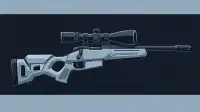

The M24 Sniper Weapon System holds an almost mythical status among precision rifle enthusiasts, a testament to its battlefield pedigree and the consistent performance it delivered for decades. For the competitive long-range shooter, however, the question isn't just about legacy, but about practical application and inherent capability. Our initial assessment of the M24 SWS isn't simply a historical appreciation; it's a critical evaluation through the lens of modern PRS and NRL demands.
At its core, the M24 is built around a Remington 700 long action, allowing for future caliber conversions beyond the venerable .308 Winchester, a foresight that still resonates today for those considering magnum cartridges. The heavy contour, 24-inch or 26-inch 5R rifled barrel, typically manufactured from 416R stainless steel (later versions were chrome-moly), is a defining characteristic. This barrel profile contributes significantly to its stability and resistance to point-of-impact shift during extended firing strings, crucial for maintaining tight groups in a PRS match. However, the sheer mass also impacts stage transitions and natural point of aim on unsupported positions.
The HS Precision PST-024 stock, with its integral aluminum bedding block, provides a rock-solid foundation, ensuring consistent receiver-to-stock interface. This rigidity is a major contributor to the M24's renowned accuracy. Yet, from a contemporary competitive perspective, the stock presents notable ergonomic limitations. The fixed length of pull and non-adjustable comb height are significant disadvantages for shooters striving to achieve optimal eye relief and a consistent cheek weld across diverse positional stages and barricade work. Modern chassis systems or fully adjustable stocks offer a clear advantage here, allowing for precise customization to the shooter's anatomy and specific stage requirements.
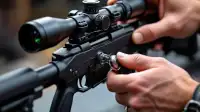
Optic mounting relies on a robust Picatinny rail and rings, typically Leupold Mark 4. While perfectly serviceable, the original fixed 10x Leupold Mark 4 M3A optic, while durable, lacks the variable magnification, advanced reticle options (like the Mil-XT or Tremor3), and ample elevation travel (typically 120-140 MRAD or 40-50 MOA) that competitive shooters now demand for engaging targets from 100 to 1200+ yards. Truing data becomes an intensive exercise with more limited internal travel, often requiring significant holdovers or complex elevation conversions.
The Remington 40X trigger, a refined version of the ubiquitous 700 mechanism, is generally crisp and consistent, breaking cleanly at around 2.5-3.5 pounds. This is suitable for precision work, though many competitive shooters prefer single-stage triggers breaking sub-2 pounds for faster splits and reduced impulse.
Ultimately, the M24 SWS, while an undeniable piece of precision rifle history, embodies a foundational design that requires significant modernization to compete effectively against purpose-built PRS/NRL rigs. Its inherent accuracy potential, largely due to the robust action and quality barrel, remains a strong point. However, the lack of adjustability and accessory integration common in modern platforms means a shooter must adapt to the rifle, rather than the rifle adapting to the shooter. Future articles will delve deeper into optimizing ammunition, velocity nodes, and exploring targeted upgrades to bridge this gap.