
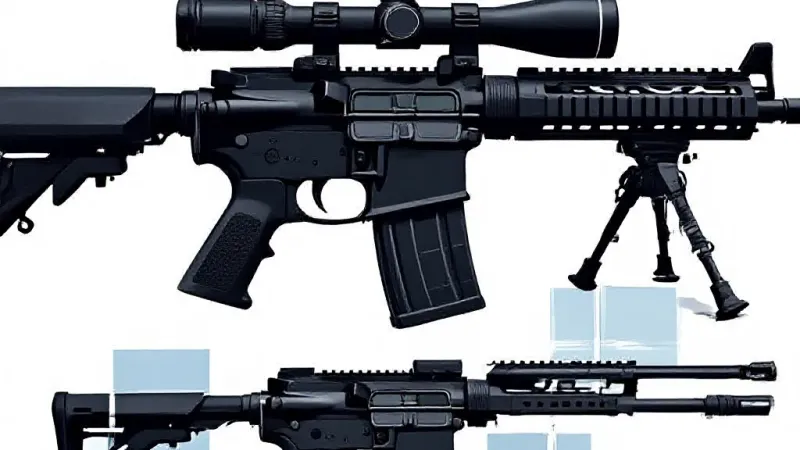
The Remington M24 Sniper Weapons System (SWS) holds a distinguished place in the lineage of precision rifles, having entered service with the U.S. Army in 1988. Built upon the robust Remington 700 long action, the M24’s design distinguished it from the hand-built Marine Corps M40 series rifles, instead opting for mass production by Remington while retaining a long action for potential future upgrades to cartridges like the .300 Winchester Magnum, despite being chambered for 7.62 NATO (effectively .308 Winchester).
The M24 featured a 24-inch stainless steel barrel with a 1:11.25-inch twist, a profile noted to be identical to the M40A3/A5/A6 series, which utilize 25-inch barrels. Its standard issue configuration included a fixed 10X Leupold scope, complemented by a back-up iron sight system. These iron sights, secured by blind screw holes on the barrel and receiver, are now considered collector's items. The rifle fed from an internal box magazine with a hinged floor plate, and the barreled action was set into a Kevlar/Fiberglass HS Precision stock featuring an aluminum bedding block and an adjustable butt plate, a significant departure from the more static varmint stocks prevalent at the time.
An individual recently acquired a used M24, noting its unknown round count and a history of “rattle can paint jobs” contributing to its character, reminiscent of a well-used military issue rifle. The reviewer observed an “elegance of simplicity” in the M24’s design. While acknowledging that contemporary options like the McMillan A2/3/5 series stocks are often regarded as ergonomically superior, the HS Precision stock was deemed entirely functional and adequate for most applications.
During an initial range session on a cold, wet autumn day, the reviewer, equipped with Federal Gold Medal 175-grain factory ammunition, engaged targets at 100 yards. The rifle’s trigger was noted as “a bit heavy,” breaking at just over five pounds. Despite forgetting a chronograph, a critical tool for load development, the session yielded promising results: a five-round group measuring .725 MOA. The reviewer reported that a cold bore shot contributed to a low flyer, with the subsequent four rounds grouping “well under .5 MOA.” The rifle’s perceived recoil was higher than anticipated for a .308 Winchester, an observation attributed to advancements in modern firearms design and the thin rubber of the adjustable butt plate.
The experience prompted a reflection on the evolution of precision shooting technology. The M24, representing the pinnacle of late-1980s sniper rifle design, starkly contrasts with today's common use of chassis systems, higher magnification optics, and forward rails for night vision. Yet, the M24’s enduring legacy and the countless stories from soldiers who carried it underscore its profound impact on the development of precision marksmanship. The rifle's simple, purposeful design serves as a tangible link to the foundations of the sport.
Upgrading the M24 can present challenges due to its long action, necessitating specialized parts. However, the consistent demand from military users, including programs like the IDF Modernization of the M24, has driven innovation in aftermarket solutions, notably with chassis systems. The reviewer expressed a strong appreciation for the M24 and plans for further exploration into its accuracy, load development, and modern upgrade options, including specific chassis systems.