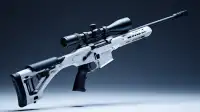
The integration of electronic technology into firearms has long been met with a cautiously optimistic outlook. While solutions like weapon-mounted laser aiming modules, red-dot sights, and even laser rangefinders have found widespread acceptance, attempts to seamlessly merge digital displays with riflescopes have historically encountered compromises.
Maztech Industries is addressing this challenge with its X4-FCS (Fire Control System), presenting a novel, modular approach. The system combines a laser rangefinder, a scope mount with a projection display, and a shooter's riflescope. This modular philosophy offers distinct advantages and trade-offs, requiring individual shooters to determine its applicability to their specific needs.
At the core of any precision rifle engagement is an accurate range to target. To this end, Maztech offers the X4-LRF, available in 2k or 15k variants, denoting maximum range capabilities under ideal conditions. Both rangefinding units are equipped with integrated Applied Ballistics software, providing not just a simple range, but a calculated firing solution. These LRF units can operate independently, and their setup mirrors that of other weapon-mounted rangefinders, with the Maztech app facilitating intuitive device and profile configuration.
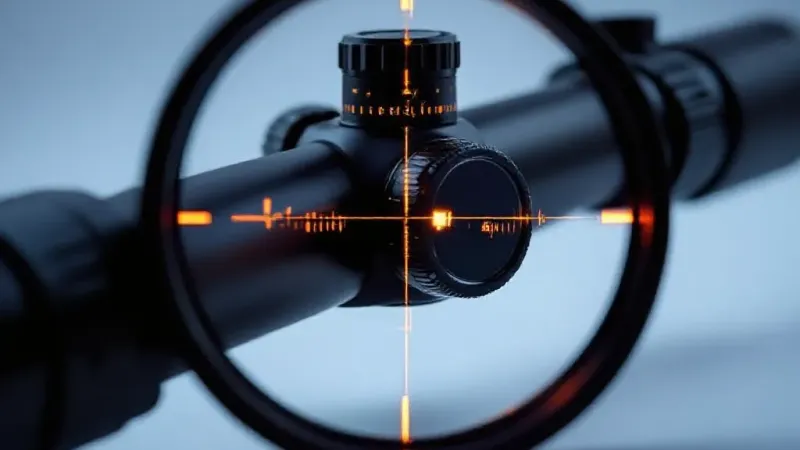
The second, and perhaps most innovative, component is the Maztech FCS scope mount/display. Diverging from past attempts to embed displays directly into optics, the FCS allows shooters to utilize their preferred riflescope. The system projects a digital display directly onto the existing reticle. It is engineered for LPVO-style optics (1-6x, 1-8x, 1-10x) with 30mm or 34mm tube diameters, leveraging their straight-tube objective lens design. Mounting is simplified by an alignment reticle within the projector, allowing for precise synchronization with the riflescope's reticle.
Like the LRF, the FCS also connects to the Maztech app and features its own Applied Ballistics software suite. It can function autonomously, with target range manually input via a roll-wheel. As range data is entered, a small aiming point—selectable between a chevron or a “T-dot” style—moves vertically, visually overlaying the scope’s reticle to indicate the ballistic solution.
The true synergy of the X4-FCS system emerges when the LRF and FCS are integrated. Via simple cable connections and a remote button press, the LRF feeds data directly to the FCS, which then projects a single visual hold point onto the riflescope’s reticle. This process provides haptic vibration feedback, signaling that the system has acknowledged the command and processed the data.
Reported observations describe a straightforward user experience where, after setup, a button press yielded a range and a green aiming point, which, for a target at 330 yards, indicated a 1-mil low hold. This was followed by a successful impact. Similar results were observed at 405 yards, even with a shooter new to long-range engagement. The alignment process involves zeroing the riflescope, then aligning the X4 laser parallel to the scope's erector tube using a supplied reflective target.
However, it's critical to note the system's limitations, particularly concerning environmental variables. While Maztech includes an option to manually input wind speed and direction for processing by the Applied Ballistics software, this process can divert attention from the shooting task. Furthermore, the accuracy of manual wind inputs is inherently questionable, and wind conditions can shift rapidly. As one analysis pointed out, the initial confidence derived from simply placing the aiming point on target and pressing the trigger can quickly erode when dynamic wind conditions are present, emphasizing that no consumer-grade technology currently accounts for wind variables on the fly.
The Maztech X4-FCS is designed to semi-automate and consolidate various tools, but it does not negate the necessity for a foundational understanding of ballistic principles. Indeed, for shooters with a solid grasp of ballistics, the standalone laser rangefinding module, with its correction outputs, might suffice for applying holdovers using their existing reticles, without the full FCS module. This raises a pertinent question regarding the system's place in the market: it occupies a space described as a “technological and unitized shortcut to long-range shooting” — a niche whose true demand remains to be fully explored. The system is noted to appear well-made, and its controls are intuitive, with seamless and easy integration of the X4 LRF.