The integration of electronic technology into firearms has long been met with a cautious optimism within the precision shooting community. While proven elements like weapon-mounted lasers, red dot sights, and laser rangefinders have gained acceptance due to their ruggedness and utility, other innovations, particularly digital displays within riflescopes, have often faced challenges in widespread adoption. Past attempts to combine a riflescope and laser rangefinder with a projected holdover point frequently involved compromises that hindered their broad appeal.
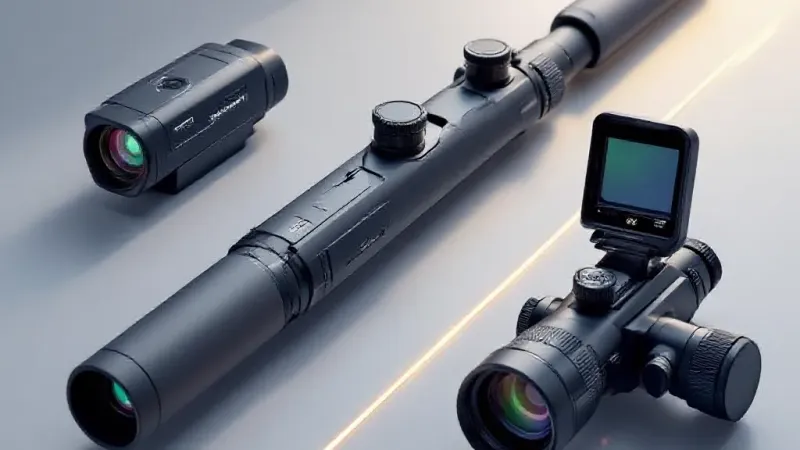
Maztech Industries is now offering a novel solution with its X4-FCS (Fire Control System), a module-based platform designed to integrate laser ranging, ballistic calculation, and visual holdover display. The system’s philosophy, using separate modules, presents both benefits and drawbacks, requiring individual users to assess its applicability to their specific needs and situations.
Central to any accurate long-range firing solution is precise range-to-target data. For this, Maztech provides two options: the X4LRF in 2k or 15k variants, denoting maximum range capabilities in meters under optimal conditions. Both rangefinding units are identical except for their ranging capacity and feature integrated Applied Ballistics software. This provides not just a raw range but a computed final firing solution. Setup mirrors other weapon-mounted rangefinders, with the Maztech app offering an intuitive interface for device settings and ballistic profile configuration.
Perhaps the most innovative component is the Maztech FCS scope mount and display module. Diverging from previous attempts to embed digital displays directly into riflescopes, the FCS allows users to mount their own optic. A digital display is then projected onto the existing reticle within the user's chosen riflescope. This design is optimized for LPVO-style optics—such as 1-6x, 1-8x, or 1-10x—with 30 or 34mm tube diameters, leveraging their straight-tube objective lens style. Mounting is simplified by an alignment reticle within the projector, allowing for precise setup with the scope’s reticle.
The FCS module also connects to the Maztech app and includes its own Applied Ballistics software suite, enabling standalone operation. In this mode, range-to-target can be input manually via a roll-wheel. As the range is adjusted, a small aiming point, selectable between a chevron or T-dot style, moves vertically over the existing scope reticle, providing a visual ballistic solution. When combined, the X4LRF connects to the FCS, allowing the laser rangefinder to feed data directly to the FCS. A remote button press initiates the ranging and data processing, seamlessly delivering a single visual representation of the necessary hold point for increased probability of first-round impacts.
Reports indicate that setting up the entire system requires dedicated time to ensure each step is complete and verified. A user who experienced the system firsthand noted that the projector's alignment reticle made scope mounting straightforward, with adjustments available for projection alignment. When the full system is utilized, it defaults to the Applied Ballistics software within the FCS unit, though ballistic profiles can be configured in both the FCS and X4 rangefinder via the app. After zeroing the riflescope, a reflective laser alignment target facilitates parallel alignment of the X4 laser to the scope’s erector tube.
In operation, a user reported that tapping the remote button provided short haptic feedback, confirming data processing. The system immediately displayed the range and adjusted a small green aiming point. For a target at 330 yards, the aiming point settled at approximately 1 mil low, consistent with expectations, leading to an impact. This process was repeated for a 405-yard target, with the aiming point dropping to 2 mils for another impact. A new shooter, fairly new to long-range shooting, also successfully used the system to achieve impacts at these distances.
However, the system's limitations regarding wind emerged when the new shooter attempted to engage a 550-yard target, resulting in repeated misses due to wind. While Maztech includes an option to manually input wind speed and direction into the Applied Ballistics software, this process can divert attention from shooting, and the validity of inputs can be questionable given the dynamic nature of wind. The initial confidence provided by simply placing the aiming point on target reportedly faded quickly when wind became a dominant factor. This highlights that despite the system’s design to semi-automate and consolidate tools, a foundational understanding of ballistics remains crucial.
The system is reported to be well-made with intuitive controls and seamless integration between the X4 LRF and FCS. However, the question remains whether it occupies a truly distinct space, potentially serving as a technological shortcut rather than a comprehensive enhancement for experienced long-range shooters who may already rely on the laser rangefinding module and apply its corrections using their existing reticles.