
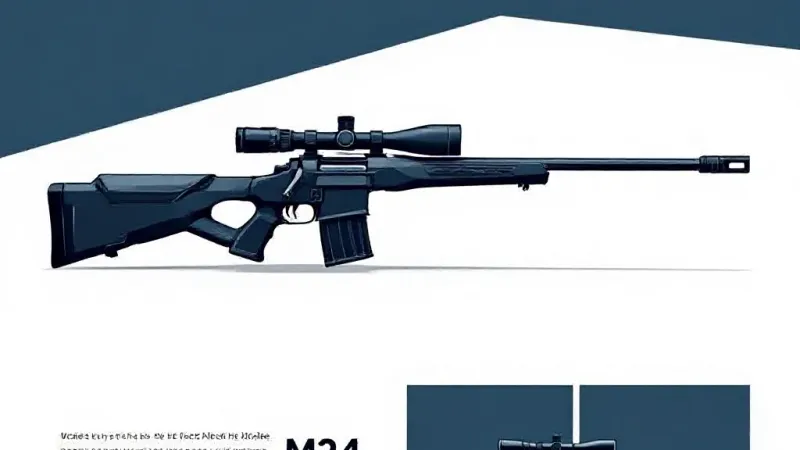
The Remington M24 Sniper Weapon System (SWS), a platform etched into the history of military precision rifle shooting, recently underwent an initial review by a seasoned long-range enthusiast, according to rifleshooter.com. The M24 SWS was formally adopted by the US Army in 1988. Unlike the hand-built Marine Corps M40 series, the M24 was mass-produced by Remington, built upon a long-action Remington 700 receiver to facilitate potential future chambering in larger cartridges like the .300 Winchester Magnum, despite its standard issue in 7.62 NATO (effectively .308 Winchester).
The M24 comes equipped with a 24-inch stainless steel barrel featuring a 1:11.25-inch twist rate. This barrel profile is noted to be identical to the M40A3/A5/A6 series, though the M40 rifles utilize a 25-inch barrel. Uniquely for its era, the M24 was issued with both a fixed 10X Leupold scope and a backup iron sight system, which secures to blind screw holes on the barrel’s muzzle end and receiver. The system feeds from an internal box magazine with a hinged floor plate, and the barreled action is bedded into a Kevlar/Fiberglass HS Precision stock featuring an aluminum bedding block and an adjustable butt plate.
The reviewer acquired a used M24 SWS, noting its unknown round count and a history of multiple rattle-can paint jobs, giving it a well-used military aesthetic. Despite its age, the rifle presented an “elegance of simplicity.” The HS Precision stock, while similar to contemporary varmint stocks and generally considered good enough for most applications, was acknowledged to be ergonomically different from options like the McMillan A2/3/5 series stocks. A cold, wet autumn day in the Northeast provided the backdrop for the initial range session.
Loading Federal Gold Medal 175-grain factory ammunition, the reviewer found the rifle fit well with no need for length of pull adjustment. The trigger, measuring a little over five pounds, was described as heavy. At 100 yards, the M24 produced a five-round group measuring .725 MOA. Notably, the cold bore shot was low, but the subsequent four rounds printed at “well under .5 MOA.” The reviewer suggested that punching the bore prior to shooting might have contributed to the first round’s deviation. Recoil perception was higher than anticipated for a .308, attributed to the thin rubber butt plate.
The experience prompted reflection on the M24’s design as a benchmark of late-1980s long-range technology, juxtaposed against modern precision rifle solutions featuring chassis systems, higher magnification optics, and night vision mounting capabilities. The review highlights the M24’s profound legacy and its role in the evolution of precision shooting. Upgrading the long-action M24 requires specialized parts, a demand historically met by military innovation, exemplified by programs like the IDF Modernization, which incorporated an MDT Chassis. Rifleshooter.com indicates future posts will delve deeper into accuracy testing, load development, and a closer look at these modernization efforts.