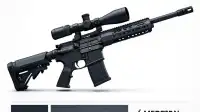

The IDF's recent modernization of its M24 Sniper Weapon System fleet offers a masterclass in pragmatic, performance-driven upgrades, demonstrating that a fundamentally sound action, when properly enhanced, remains competitive in the modern long-range landscape. Rather than adopting an entirely new platform, the Israeli Defense Forces have opted to significantly overhaul their existing Remington 700 long-action M24s, focusing on modularity, ergonomics, and optical superiority – crucial elements for today's precision rifleman.
The cornerstone of this transformation is the integration of a modern aluminum chassis, replacing the dated McMillan A1-3 stock. While specific chassis details are often classified, the benefits are universal: enhanced adjustability for length of pull and comb height, crucial for maintaining consistent head position and eye relief across various shooters and shooting positions. Furthermore, the chassis provides a rigid bedding surface for the barreled action, minimizing deflection and contributing to repeatable accuracy. The likely incorporation of M-LOK or similar attachment points on the forend allows for direct mounting of bipods, barricade stops, and other accessories, a significant ergonomic and functional upgrade for positional shooting scenarios common in both military and competitive environments.
Optics have also received a substantial upgrade. The fixed-power Leupold M3A, while iconic, is ill-suited for the dynamic engagement ranges and rapid wind holds demanded by modern precision work. The IDF's choice to move to contemporary variable-power, first focal plane (FFP) optics with advanced MRAD reticles (likely from manufacturers like Nightforce, Schmidt & Bender, or Vortex) unlocks capabilities previously unavailable. This enables rapid ranging, precise holdovers and wind calls, and significantly improved light transmission and resolution at extended distances. Such an upgrade directly impacts the shooter’s ability to build a comprehensive DOPE card and execute rapid engagements, critical under combat stress.
While the M24 remains chambered in the venerable 7.62x51mm NATO (.308 Winchester), the rebarreling program, likely incorporating heavier contour, match-grade barrels, ensures optimal projectile stability and consistent velocity. The inherent precision of the Remington 700 action, combined with these modern enhancements, validates the enduring principle that shot placement, driven by a stable platform and clear reticle, trumps raw cartridge power in many scenarios. For PRS and NRL competitors, this modernization underscores the value of investing in quality components that directly influence accuracy, ergonomics, and data management. It’s a testament to optimizing a proven system rather than chasing the next shiny object, yielding a potent, combat-ready precision instrument for the contemporary battlefield.