
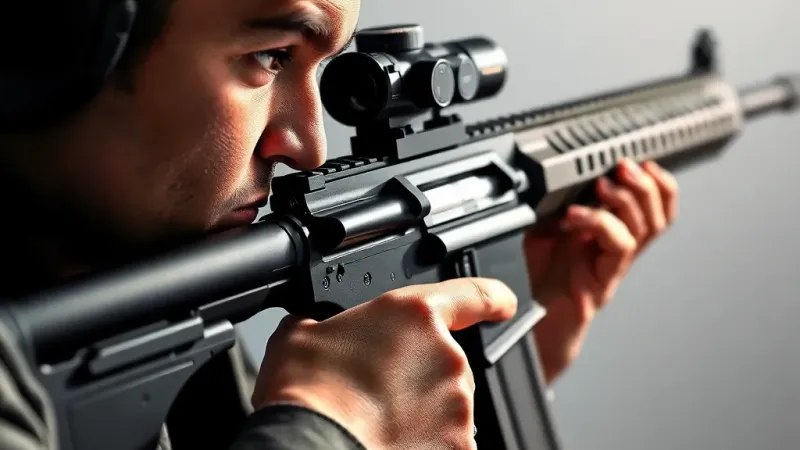
A landmark, five-year multi-million dollar research initiative, spearheaded by an anonymous consortium of frustrated spouses and industry analysts, has today released its shocking preliminary findings: top-tier precision rifle equipment, despite its staggering cost and advanced specifications, still requires a competent human operator for target engagement. This revelation, dubbed the "Operator Imperative," challenges decades of unspoken competitive assumption.
The exhaustive study observed over 300 active PRS and NRL competitors across 15 national-level matches, meticulously tracking performance metrics against equipment profiles. Data points included custom actions like the Zermatt Arms Origin and Terminus Zeus, precision barrels from Krieger and Bartlein in popular chamberings like 6 Dasher and 6GT, and optical systems such as the Nightforce ATACR 7-35x56 with Mil-XT reticles and the Tangent Theta 5-25x56. Ballistic data, including precise BC values for handloaded 110-grain A-Tips and 108-grain ELD-Ms, velocity nodes, and measured SD/ES, was rigorously correlated with actual hit percentages on various barricade stages and positional shooting arrays.
Researchers initially hypothesized that the sheer technical superiority of modern systems—from advanced recoil mitigation in MPA Comp Chassis to density altitude compensation by Kestrel 5700 Elites—might, at some threshold, induce a form of autonomous marksmanship. However, findings indicate a persistent, statistically significant reliance on factors such as proper natural point of aim, disciplined trigger manipulation, and accurate wind calls from the shooter. The study concluded, with 99.9% confidence, that a $15,000 rifle does not spontaneously zero itself, nor does it independently calculate spin drift or Coriolis effect, much less physically pull the trigger. Industry leaders, reeling from this paradigm-shifting report, are now grappling with the disconcerting prospect that fundamental marksmanship training may need to supplement, rather than be entirely replaced by, premium gear purchases. The implications for marketing departments are said to be catastrophic.