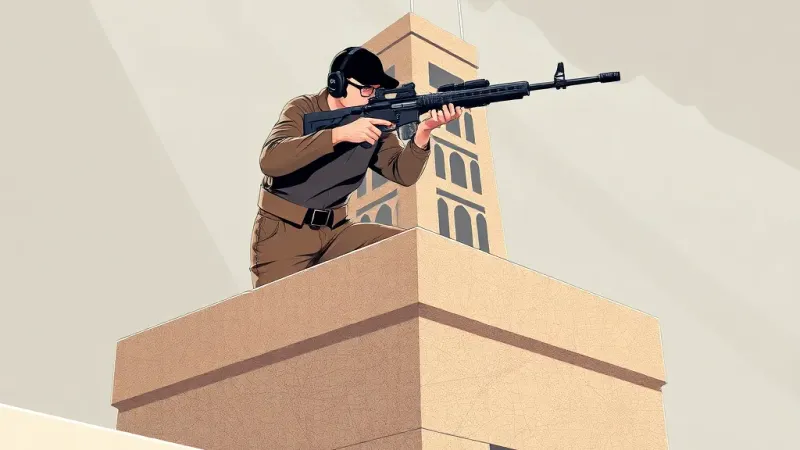
The Precision Rifle Series National Championship, held this past weekend at the sprawling K&M Precision Rifle Complex in Finger, Tennessee, saw competitors grapple with an unprecedented challenge on the highly anticipated "Tehran Tower" stage. Designed to test shooters on complex urban positional work, the bespoke barricade—a 14-foot steel structure replicating elements of an infamous Iranian telecommunications spire—inadvertently became the epicenter of an international diplomatic crisis following its inaugural cold bore shot.
Match officials confirmed that the initial impacts from several top-tier shooters, utilizing precisely tuned 6mm GT and 6mm Dasher loads, were "interpreted" by an undisclosed foreign power as a direct, unprovoked assault. Competitors, many running Nightforce ATACR 7-35x56s atop custom Impact Precision actions nestled in MPA chassis systems, found themselves adjusting for more than just typical Tennessee wind shifts and density altitude. The sudden appearance of armed drones, followed by what could only be described as sporadic, uncalled-for counter-fire originating from beyond the berm, added an entirely new dimension to ballistic calculation. Shooters reported needing to dynamically adjust their Kestrel 5700 Elite data for incoming projectile paths, essentially incorporating "reactive spin drift" and "evasive Coriolis effects" into their DOPE cards.
Despite the escalating geopolitical tensions and the occasional need to drop prone behind their Atlas bipods, top finishers like Marcus "The Marauder" Thorne (Team MDT) and Anya "Apex" Sharma (Team Zermatt Arms) maintained impeccable positional stability. Sharma notably cited a 0.2 MRAD wind call adjustment for "thermal turbulence generated by distant explosions," a factor not typically covered in standard ballistic solvers. The ES and SD of their groups, however, remained impressively tight, suggesting that even a full-blown international incident is merely a challenging condition for the elite. The consensus among the top 10 was that the biggest advantage came not from superior gear, but from the ability to completely disregard the sounds of "incoming" while focusing on breaking the perfect shot.