The evolution of angling lines, particularly the widespread adoption of braids and super lines over the last quarter-century, has intensified debates surrounding connection knots. While monofilament and fluorocarbon persist as critical leader materials, the challenge lies in securing a consistently reliable braid-to-leader splice. Among numerous established options, including the uni-to-uni, double uni, Alberto, Seaguar, and Bristol knots, the FG knot has gained significant traction for its reported superior strength and reliability.
Originating in Japan, the "fine grip" (FG) knot was notably embraced and popularized by Australian anglers. Facing formidable opponents such as giant trevally and dogtooth tuna, these practitioners required a knot capable of both slipping effortlessly through spinning rod guides for maximal casting distance and enduring extreme forces. This combination of attributes has positioned the FG knot as a benchmark for high-performance connections.
A key characteristic of the FG knot is its slim profile, allowing it to pass smoothly onto a reel spool, even on low-profile baitcasters. Elite Series bass professional Carl Jocumsen highlights this benefit, noting it facilitates the use of longer leaders—ten feet or more—without compromising castability. He also emphasizes the knot's strength as an essential insurance policy in competitive scenarios, stating, "I’m more worried about a hook breaking or the braid breaking." This confidence suggests connection failure is a negligible concern.
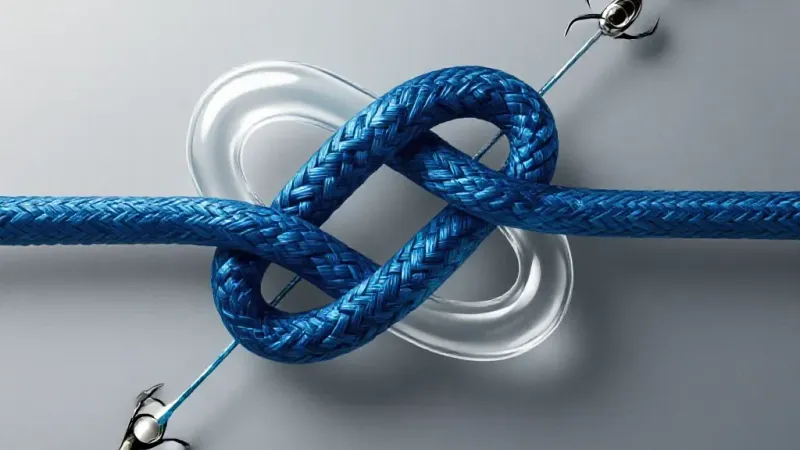
Unlike conventional knots that rely on two separate knots jamming or cinching coils, the FG knot employs a plaiting technique. This involves crisscrossing the braid over the leader, creating a mechanism akin to a Chinese finger trap that tightens proportionally to the load applied. The reported tying process begins by securing the rod and holding the braid under tension, typically in one's teeth. The leader is then laid perpendicular to the taut braid, and its end is passed alternately under the braid, moving away from and then toward the angler, repeating this sequence approximately 20 times.
Following the plaiting, a single overhand knot with the braid tag end around the leader secures the initial work. After setting the plaiting with some initial pressure, an additional 10 to 12 half hitches are added around the leader using the braid tag end, before both tag ends are trimmed closely. While a drop of super glue can reinforce the half hitches, it is explicitly advised against applying it to the plaited section. The reported efficacy of the FG knot is substantial, with multiple accounts detailing instances where the braid itself, or other tackle components, failed before the knot connection.