
The pursuit of extreme long-range precision is an iterative dance between ballistic theory, environmental reality, and shooter execution. For veteran precision rifleman Alex Chen, this dance took on a personal obsession with a 1500-yard steel plate he affectionately dubbed "The Mirage Monster." Situated in a thermal-churning draw notorious for its erratic crosswinds and boiling air, the 1 MOA target was a known quantity, but consistently hitting it first-round was a different beast entirely. Chen's initial engagements, while yielding impacts, were inconsistent in their FRI rate, pushing him to dissect every variable.
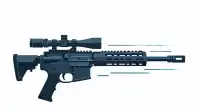
Running a meticulously built 6.5 PRC — a Bighorn Origin action, a 26-inch Krieger Heavy Palma barrel nestled in an MDT ACC chassis, topped with a Tangent Theta 5-25x56 utilizing the Gen 2 XR reticle — Chen knew his hardware was beyond reproach. His handloaded 147gr Hornady ELD-M ammunition, propelled by H1000, consistently delivered single-digit SDs, confirming the platform's mechanical precision. The challenge wasn't the rifle; it was the dynamic environment and the granular refinement of his trued DOPE.
Chen's first dedicated session against "The Mirage Monster" involved logging every data point. A Kestrel 5700 Elite provided density altitude, station pressure, and wind speed/direction, cross-referenced with multiple wind flags and mirage analysis through his spotting scope. He noted the subtle, yet significant, shifts in wind vectors and how the thermal currents warped the target image. His initial ballistic profile, while robust, showed slight discrepancies when engaging past 1200 yards in these specific conditions. He observed that even a seemingly minor change in sun angle or atmospheric pressure would subtly alter the wind's behavior within that particular draw.
Returning for a second round of engagements, Chen focused on micro-adjustments to his ballistic solver. He suspected the effective G7 BC was behaving differently under these extreme conditions, or perhaps his estimation of spin drift and Coriolis effect needed a slight tweak to harmonize with his observed impacts. He began categorizing wind calls not just by speed and direction, but by their *duration* and *stability* relative to the mirage. This allowed him to identify brief "windows" of more predictable air.
His third attempt proved revelatory. Armed with a deeper understanding of the range's unique microclimate and a meticulously trued ballistic profile, Chen executed three consecutive first-round impacts on "The Mirage Monster." This wasn't a world record in the traditional sense, but it represented a profound personal best in data mastery and execution under exceptionally difficult, repeatable conditions. It underscored a fundamental truth in precision shooting: the target often reveals the limits of your data, and consistent, iterative engagement is the only path to true mastery. Every "miss" became a data point, every impact a confirmation, until the seemingly impossible became a repeatable reality.