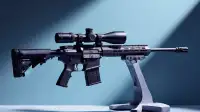
The reality for many competitive shooters aspiring to excel in PRS and NRL is often limited access to dedicated long-range facilities. While engaging steel at 800, 1000, or even 1200 yards provides invaluable feedback, the vast majority of critical skill development and system verification can, and should, happen much closer to home. True long-range performance isn't just about shooting far; it's about absolute mastery of the fundamentals that translate across all distances.
The foundation of any precision rifle system begins with a rock-solid 100-yard zero. This isn't just about impact point; it's about establishing your ballistic baseline. Utilize a MagnetoSpeed V3 or LabRadar to accurately capture your muzzle velocity and extreme spread for your chosen load, whether it’s a 6mm Dasher pushing 105gr Hybrid Targets or a 6GT launching 110gr A-Tips. This data is critical for accurate ballistic calculator inputs, allowing you to generate reliable DOPE cards that will only require minor truing at distance.
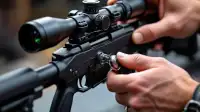
Next, verify the mechanical integrity of your rifle and optic. Execute a tall target test at 100 yards to confirm your optic's tracking and subtension accuracy. A premium optic like a Nightforce ATACR 7-35x56 or a Tangent Theta 5-25x56 with a Mil-XT reticle should track perfectly, but verification is non-negotiable. Confirm that your reticle true matches your turret movements and that your turrets return to mechanical zero reliably. This builds critical confidence in your dialing solutions when significant elevation adjustments are required for extended ranges.
The 100-yard line is also an exceptional proving ground for positional shooting. Set up a barricade, deploy a Tripod (e.g., a Really Right Stuff TFCT-24L with an Anvil-30 head), or simulate natural terrain features. Focus on building stable shooting positions, mastering your natural point of aim, managing recoil impulse, and executing a clean, consistent trigger break. Practice smooth transitions between positions and utilize dry fire drills extensively to refine your shot process without expending precious ammunition. This training focuses on the consistent execution of mechanics, which is paramount whether the target is at 100 or 1000 yards.
While you can't physically observe 1000-yard impacts, you can simulate environmental factors. Use a Kestrel 5700 Elite to pull realistic wind data for hypothetical longer distances, practicing mental wind calls and applying the correct hold or dial. Simultaneously, rigorously track your ammunition's velocity SD/ES with your chronograph. Understanding your load's consistency directly translates to less vertical dispersion at distance—a critical factor often overlooked in short-range practice. Identify velocity nodes and refine your handloads to minimize spread.
Ultimately, success in PRS and NRL often boils down to fundamental mastery and unwavering confidence in your system. While a dedicated long-range facility offers invaluable feedback, the core of your critical skill development and equipment verification can, and should, happen at 100 yards. Don't let limited range access be an excuse; leverage the short game to dominate the long game.