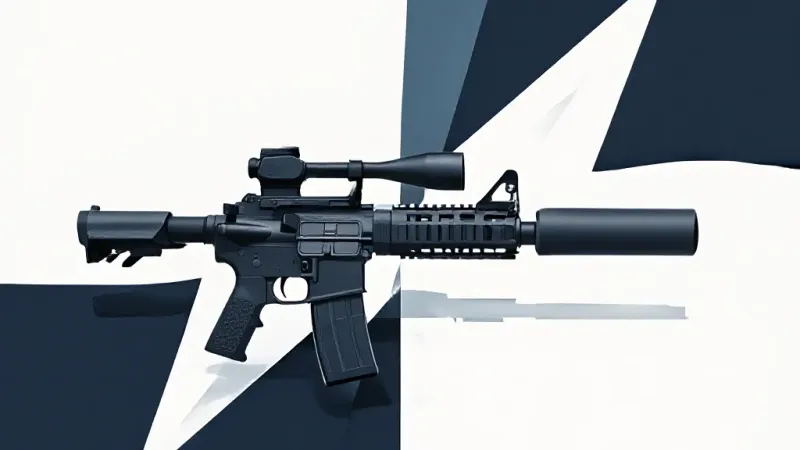
The question of how a rifle suppressor influences muzzle velocity has long been a point of discussion within the precision rifle community. Competing theories suggest everything from a substantial velocity increase—akin to lengthening the barrel—to no discernible effect at all. For competitive shooters in PRS and NRL, understanding this interaction is crucial for accurate ballistic solutions, especially when managing DOPE across varied conditions.
To contribute to this ongoing dialogue, an individual conducting an extensive data gathering process has shared preliminary findings. The research aims to explore these velocity dynamics by comparing identical loads fired from the same rifles, both with and without a suppressor. It's noted that this is part of a 'never ending data gathering process,' highlighting the iterative nature of such empirical work.
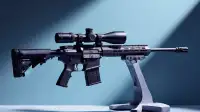
One set of observations focused on a Ruger Precision Rifle chambered in 6.5 Creedmoor. Using a Q LLC suppressor, five distinct 142 gr SMK loads were compared. The results revealed a mixed pattern: for three of the five loads tested, the non-suppressed rifle recorded a higher muzzle velocity. Conversely, for the remaining two loads, the rifle equipped with the suppressor displayed a higher muzzle velocity. This suggests that the impact is not uniform and can vary even within different loads from the same rifle and suppressor combination.
A separate set of observations, involving a Lithgow rifle paired with a Q can, similarly showed nuanced results. In this instance, the data indicated that 'with some ammunition a slight advantage with the suppressor is present.' While less granular than the Ruger Precision Rifle findings, this observation further supports the notion that any velocity change is not consistently positive or overwhelmingly significant across all ammunition types.
Based on the accumulated data thus far, the individual conducting the research summarized that it is fair to say that "suppressors have a negligible effect on muzzle velocity." For the precision rifle competitor, this preliminary conclusion carries significant implications. A negligible effect suggests that while minor velocity shifts may occur, they are unlikely to be substantial enough to warrant major adjustments to a shooter's ballistic profile or truing data, particularly when considering the inherent variations (SD/ES) typical of handloaded ammunition.
In practical terms, this implies that the primary ballistic concerns when adding a suppressor—such as potential zero shift due to barrel harmonics or point-of-impact changes—might remain more critical than re-truing muzzle velocity. While precise data for every rifle and load combination is always ideal, these findings suggest that the average velocity delta introduced by a suppressor might fall within the margins of error or typical environmental corrections that competitors already manage on the stage. As more data is gathered and analyzed, the community will undoubtedly gain a deeper understanding of these complex interactions, further refining our approach to precision rifle system optimization.