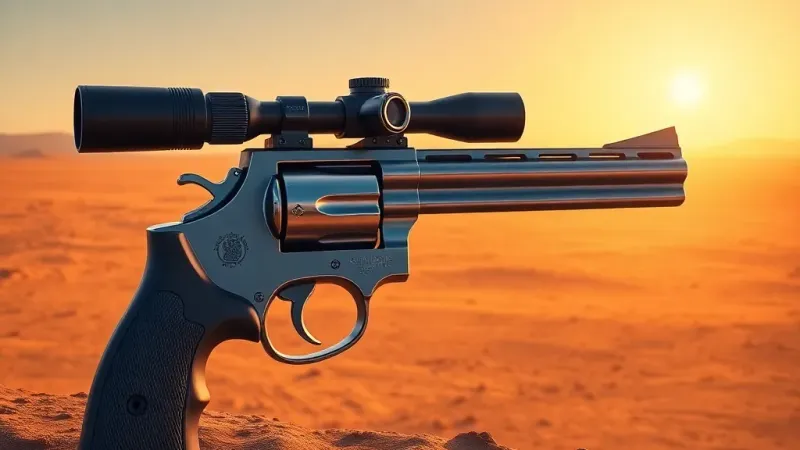
The competitive long-range community finds itself collectively scratching its head this week as Smith & Wesson's Performance Center unveiled its latest iteration of the Model 629, chambered, of course, in .44 Magnum. Designated the 629 PC, this 6-shot, 6.5-inch ported stainless steel revolver features a tuned action and a highly visible red ramp front sight, ostensibly designed for "precision." While certainly a fine piece of wheelgun craftsmanship, its sudden emergence into the public discourse has raised eyebrows regarding its proposed utility in the ELR or PRS arena.
Sources close to ColdBore indicate a groundswell of speculation that the 629 PC might represent a radical, if ill-advised, bid to redefine extreme long-range engagements. Early tests, reportedly conducted at distances up to 50 yards, demonstrate surprisingly tight groups, though extrapolation of a 1.5-inch group at 50 to a target at 1200 yards presents significant challenges for even the most optimistic ballistic calculator. Competitors are already debating the optimal .44 Magnum projectile for trans-sonic flight, with emphasis on maintaining stability past the 200-yard mark — a task historically reserved for dedicated rifle rounds boasting G7 BCs significantly higher than a flying brick.
Truing data for a projectile with an average SD/ES that rivals typical muzzle velocity variations across a full year of seasonal matches will be a new frontier. Determining a reliable velocity node for consistent performance beyond the 100-yard cold bore shot promises to consume vast quantities of premium .44 Magnum brass. Furthermore, developing a solid DOPE card for a bullet that requires a full 14 MRAD of elevation just to reach 400 yards, before factoring in a 10 mph full-value wind call that pushes it 6 feet off target, will require unprecedented commitment. We anticipate many competitors will find themselves practicing barricade technique with one hand while simultaneously adjusting for Coriolis with the other.