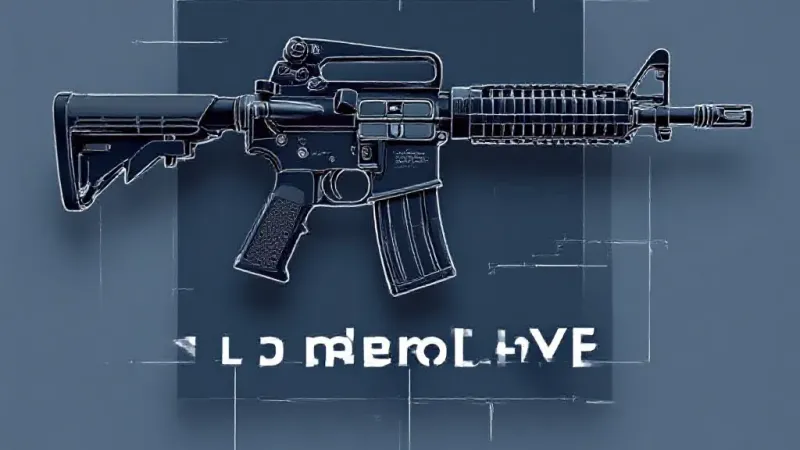
For many, the Ruger Mini-14 conjures images of robust reliability rather than sub-MOA precision. Its gas-piston driven, self-cleaning action and classic lines have cemented its place in firearms history, but rarely on a precision bench or competition stage. However, an intriguing technical exercise lies in exploring just how far one can push the inherent accuracy of this platform, applying the same principles of barrel dynamics, trigger mechanics, and ammunition optimization we employ on purpose-built precision rifles.
The inherent challenges of the Mini-14 platform primarily stem from its thin, pencil-profile barrel. This design choice, while aiding in maneuverability and weight reduction, severely compromises accuracy due to rapid heating and subsequent point-of-impact (POI) shift as barrel harmonics change. The most impactful upgrade for any Mini-14 aspiring to tighter groups is a re-barrel. Opting for a heavier contour, match-grade barrel from a reputable manufacturer, chambered precisely, will dramatically improve thermal stability and vibrational consistency. Furthermore, selecting an optimal twist rate for heavier, match-grade .223 projectiles (e.g., 1:8 or 1:7 for 69-77 grain OTMs) is critical, as is a precisely cut target crown.
Beyond the barrel, the factory trigger unit is another significant hurdle. A heavy, inconsistent trigger pull makes precise shot placement a considerable challenge. Aftermarket trigger groups or professional trigger work to reduce pull weight, eliminate creep, and ensure a crisp break are essential steps. Simultaneously, securing a robust and repeatable optics mounting solution is paramount. The Mini-14's design, with its integral scope rings and gas block-mounted options, can present issues with zero retention. Stable, receiver-mounted rail systems are crucial for maintaining consistent zero, particularly when dealing with the platform's inherent vibration characteristics.
Finally, and perhaps most critically for any semi-automatic seeking precision, handloading for optimal performance is non-negotiable. Developing a precise load involves meticulously working up an optimal charge weight (OCW) that exhibits minimal standard deviation (SD) and extreme spread (ES) in velocity, ideally finding a velocity node that minimizes sensitivity to slight powder charge variations. This process, coupled with selecting high-quality match components—consistent brass, premium primers, and high-BC projectiles—is paramount. The interaction between the gas system and ammunition choice also plays a role, influencing cyclic rate and consistency.
Even with these considerable modifications, it's important to approach a customized Mini-14 with realistic expectations. The fundamental action design, particularly its fixed ejector and rotating bolt, coupled with its relatively open gas system, inherently limits the ultimate precision compared to modern bolt actions or even highly tuned AR-pattern rifles. The exercise is less about transforming it into a PRS contender and more about understanding the engineering principles behind accuracy and applying them to a platform not traditionally associated with sub-MOA performance, extracting its absolute maximum potential within its given design envelope.